by Gerhard Mayer, PA President




by Gerhard Mayer, PA President
When I began working as a research fellow at the Institute for Frontier Areas of Psychology and Mental Health (IGPP), one of my first projects was a longitudinal study of press coverage of topics related to anomalistics, including parapsychology, in two leading German print media outlets (Mayer, 2004). These were the renowned weekly magazine Der Spiegel and the tabloid newspaper Bild, a sensationalist publication whose focus, as its name suggests (“Bild” = photo/illustration), is on presenting stories with short texts and numerous photographs. The period under investigation ranged from 1947 (Der Spiegel) and 1949 (Bild) to 1999. The aim of this study was to gain insight into the style of argumentation and the treatment of paranormal or anomalistic topics, to compare both print media with their different readership, and to determine the frequency of reporting over the years. Were there differences and trends both in terms of the frequency of articles and the reporting itself, and what factors influenced topic careers, if any?

Although the findings of this extensive study reflected the situation in Germany during the 50 years following the end of World War II, some of them are likely applicable to other Western industrialized nations. While the tabloid press primarily, and as expected, focused on producing sensational stories, and its approach to the paranormal was tailored to this goal—that is, it did not adhere to any particular worldview or interpretation—Der Spiegel felt obligated to “enlighten” the public. During the period under investigation, Der Spiegel possessed one of the world’s largest press archives. Its articles were considered well-researched (though not necessarily neutral),[1] with the data they contained being absolutely reliable and well-documented. This, however, did not apply to articles on anomalistic or paranormal topics. In these cases, the authors, who, according to the policy of the magazine, almost always remained anonymous during its first 50 years of existence, uncritically adopted the positions and arguments of skeptics, such as Martin Gardner, following the publication of the German translation of his book Science, Good, Bad, and Bogus (Gardner, 1981, 1983).
Since they saw themselves as skeptical “enlighteners” and fighters against superstition and the like, they employed two main strategies to refute and discredit facts and evidence regarding the paranormal: a model-based strategy and a person-based strategy. The model-based strategy consists of citing facts only as long as they fit the explanatory models accepted by Der Spiegel. When this is no longer the case, they are simply ignored or reinterpreted in such a way that they fit again. One example is the use of the concept of the placebo effect, which has only been taken seriously and researched by science as an important factor for about two decades, and that was used by Der Spiegel in the function of what I called an “explanatory placebo.” For example, the concluding comment on a report about a faith healer read: “The overall result of her elaborate efforts… is virtually zero: apart from placebo effects, the girl… achieved nothing” (Der Spiegel, 1992, Issue, 16, p. 287, translated by G.M.).
The example of how this magazine handled hypnosis was particularly illustrative of the model-related strategy for defusing the seemingly inexplicable or paranormal. Although hypnosis was not yet fully understood in the 1940s and 1950s, it was recognized in press reports by Der Spiegel as a scientific method capable of achieving effects that seem incredible from today’s perspective. For example, drastic experiments were reported in a relatively uncritical manner, in which participants under hypnosis were given extremely high doses of anesthetics or subjected to high-voltage electric shocks, which ended without lasting damage. In 1958, an article appeared in Der Spiegel about a paper published in the renowned British Medical Journal (Kelsey & Barron, 1958) concerning an unusual skin transplant in which the patient was “fixed” in a bent posture for 28 days using hypnosis until the skin flap healed. Given the reputation of the journal and the credibility of the scientists involved, there was no room for doubt regarding the credibility of this intervention, which seems spectacular from today’s perspective; questions about the psychological and physiological conditions and mechanisms of action were not raised. In the 1960s, Der Spiegel’s approach to hypnosis changed significantly after no scientific explanation emerged for the dramatic effects that could be achieved under hypnosis. Although it was still recognized as a scientifically effective method, it no longer served as an explanatory model for unusual and puzzling phenomena. Its scope of application was largely limited to the therapeutic setting and, within that context, to the treatment of minor and/or psychosomatically induced conditions (warts, atopic dermatitis, anxiety). There was no longer any mention of spectacular effects attributed to the induction of hypnosis. They were simply ignored because they no longer fit into the modern, “toned-down” image of hypnosis. Once it became clear that the mysteries of hypnosis were not so easily unraveled, the Spiegel authors shifted their argument from when it was accepted as a natural or conventional explanation to a possible paranormal phenomenon. The press coverage deliberately adapted its selection of presented facts to acquiesce to the prevailing understanding of what was considered scientifically plausible.
The press coverage deliberately adapted its selection of presented facts to acquiesce to the prevailing understanding of what was considered scientifically plausible.
The second person-based strategy for downplaying potential paranormal content involves prejudging or discrediting the individuals involved. Sometimes this is done very subtly; in other cases, it is quite obvious. The approach usually involves searching for critical characteristics in a person’s (a scientist’s or medium’s) background that have nothing to do with the reported content from the frontier areas of science, but are then generalized. Associations with the “wrong” people or “wrong” beliefs are used to discredit someone. For instance, Der Spiegel published a commentary on the release of the book Abduction by the American psychiatrist John Mack (1994). The author’s critique draws on statements by Mack that have nothing to do with the actual subject matter, namely that Mack believes in reincarnation and has been reborn several times. The commentary concludes with the following remark: “His last reincarnation, as anyone with even a shred of common sense would agree, would have been better off not having taken place” (Der Spiegel, 1994, Issue 21, p. 232, translated by G.M.)
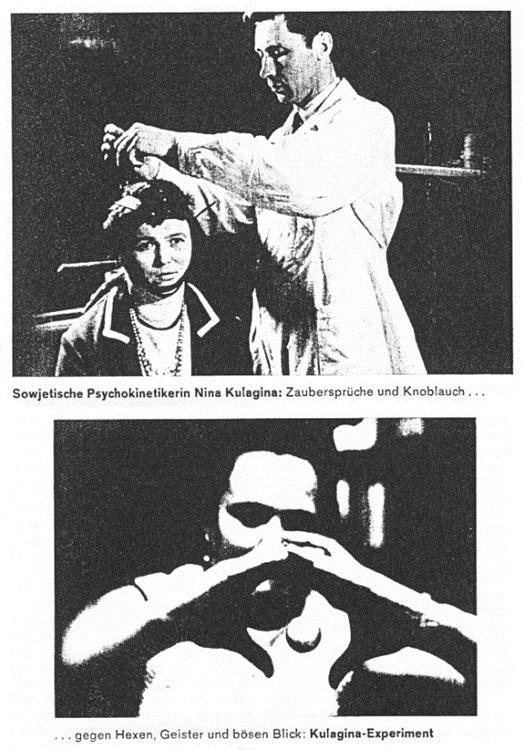
The illustration of a text, as well as a specific type of image caption, can also contribute to placing a person in a false context and thus undermining their credibility. This can be demonstrated using the example of reporting on the well-known Soviet medium Nina Kulagina: In a 1975 “Spiegel Report on Superstition in Socialist States” (Der Spiegel, 1975, pp. 76–79), there are two photos of her taken (see below) while she was participating in scientific laboratory experiments. The (two-part) caption reads: “Soviet psychokinetic Nina Kulagina: Spells and garlic … / … against witches, ghosts and the evil eye: Kulagina experiment” (Der Spiegel, 1975, emphasis in the original, translated by G.M.). The emphasis in bold suggests that the first and last parts of the caption belong together. The intervening section—which refers to the text and is linked semantically to the framing parts by the two colons—places the Kulagina experiments on the same level as popular superstition.
These strategies can still be found in publications and other media products, even though the media landscape has fundamentally changed in the last two decades. They seem to be part of human psychology—strategies for simplifying life and coping mechanisms for dealing with ambiguity. A third strategy, used by the two prominent skeptics Arthur Reber and James Alcock (2019, 2020), which consists of completely ignoring scientifically collected data (“the data are irrelevant”), is ideological in nature and therefore does not belong to the realm of science. I do not believe that this has become a general strategy of downplaying the paranormal in media coverage outside the areas of ideological skepticism and esotericism.
Apart from these two general argumentation strategies, which are part of the skeptics’ “toolbox,” so much has changed in the media landscape that the results of my study are probably only applicable to the current situation to a limited extent. With the rise of online content, print media has lost much of its significance. Online media is published much more frequently, and audiences expect news at short intervals, which inevitably limits the time available for research. While AI can be helpful as a research tool in this context, it also increases the likelihood of errors. This is especially true for topics that fall outside the mainstream of science. In this case, it is not ideological reasons that lead to a distorted representation, but simply the power of the masses, which is shaped by prevailing opinion and prevails for statistical reasons, since LLMs operate on this principle.
However, this is actually the less serious aspect of the possible negative consequences of using AI when it is used in media coverage of anomalistic or parapsychological topics. It has become easier than ever to fabricate data on a large scale and to produce and spread false information. The scientific community now is threatened by AI-generated studies, expert reports, and publications (Northwestern University, 2026).
Anomalistics and parapsychology have faced the problem of delegitimization from the very beginning through the production of pseudo-phenomena by skeptics or pranksters (Mayer & Schetsche, 2016). The simple argument, in this regard, is: if the supposedly anomalous phenomena can be produced using conventional means, then they are not anomalies and there is no need to investigate them further. Yet, the number of these fake productions (crop circles, UFOs, bent spoons) remained manageable, and the forgers often confessed to their actions, as they believed they were acting out of noble motives (the “brights” have to enlighten the “fools”).
With the increasingly accessible possibilities of editing visual media via software in such a way that the manipulations are difficult to detect, the problem of falsified data has reached a new level. Photographic and film material was invalidated as evidence to prove the existence of anomalies. The ubiquitous use of AI has exacerbated the problem exponentially. As a music lover, I was initially thrilled, and then shocked, when I came across numerous supposedly “rediscovered recordings” of blues singers on YouTube that sounded amazing but turned out to be AI-generated. The shocking moment came when I stumbled upon “rediscovered recordings” of the historically real musician Memphis Minnie, which had also been generated by an AI. Such products, created for purely commercial reasons (clickbaiting), distort our cultural history and thus fundamentally endanger our culture.
What would happen if we suddenly stumbled upon experimental parapsychological studies with significant results and remarkable effect sizes, whose authors were previously unknown to us? Would we believe them? How would skeptics and the scientific mainstream react? At least in this respect, it is an advantage that the research community in anomalistics and parapsychology is small enough to keep track of and that hardly anyone chooses these fields of research with the aim of pursuing an academic career.
But this is just a side note regarding the uncertainty that the use and possibilities—both positive and negative—of AI bring with them. The emergence of such powerful, culture-transforming new factors within a very short period of time, the acceleration of information generation and dissemination through online media, the loss of control over information flows due to the emergence and use of social networks, and the readily available means of creating fake news and false realities through AI exceed humanity’s ability to realistically predict how social and cultural developments will be reflected in the media, not to mention their specific impact on media coverage of parapsychological and anomalistic topics.
In my study, I found clear evidence of agenda setting. The media coverage often showed strong correlations between film premieres, new book releases, or anniversaries and the treatment of corresponding topics...
In my study, I found clear evidence of agenda setting (McCombs et al., 2014). The media coverage often showed strong correlations between film premieres, new book releases, or anniversaries and the treatment of corresponding topics—for example, the premiere of the film The Exorcist (1973; directed by William Friedkin) led to a considerable number of articles, including those about the churches’ stance on belief in the devil and exorcism. Agenda-setting is no longer so strongly dominated by a few leading media outlets, but is in the hands of more people than ever before, because the target audience has also gained considerable influence through clicks, likes, and dwell time. New research in cultural and media studies, perhaps with the help of AI, is necessary.
What we learned after the introduction of the internet as an information network—namely, that it is neither a good nor a bad working tool in itself—naturally also applies to AI. Its potential is, as we know, enormous, and it depends on how we use it and how we regulate that use—that determines whether it does good or bad (Harari, 2024). It would be fatal if we left it solely to the free play of forces, how AI is used to generate sensationalist content and false realities—topics from anomalistics and parapsychology are particularly well suited for such creations—if clickbaiting and thus a purely amoral capitalist principle prevails. If it becomes almost impossible to distinguish real content from fake content, and verifying authenticity becomes increasingly difficult, then we could soon reach a point where “the data are irrelevant” (Reber & Alcock, 2019, p. 8) because they can no longer be trusted. That would help neither the ideological skeptics, the skeptical-open researchers, nor the believers.
[1] It would go too far here to explain the technique used by Der Spiegel to distort the facts while relying on precise data.
Gardner, M. (1981). Science, good, bad, and bogus. Prometheus Books.
Gardner, M. (1983). Kabarett der Täuschungen. Ullstein.
Harari, Y. N. (2024). Nexus: A brief history of information networks from the Stone Age to AI (1st ed.). Random House.
Kelsey, D., & Barron, J. N. (1958). Maintenance of posture by hypnotic suggestion in patient undergoing plastic surgery. British Medical Journal, 1, 756–757. https://doi.org/10.1136/bmj.1.5073.756
Mack, J. E. (1994). Abduction: Human encounters with aliens. Scribner.
Mayer, G. (2004). Phantome—Wunder—Sensationen: Das Übernatürliche als Thema der Presseberichterstattung. Gesellschaft für Anomalistik.
Mayer, G., & Schetsche, M. (2016). On anomalistics research: The paradigm of reflexive anomalistics. Journal of Scientific Exploration, 30(3), 374–397.
McCombs, M. E., Shaw, D. L., & Weaver, D. H. (2014). New directions in agenda-setting theory and research. Mass Communication and Society, 17(6), 781–802. https://doi.org/10.1080/15205436.2014.964871
Northwestern University. (2026). Scientists warn fake research is spreading faster than real science. ScienceDaily. https://www.sciencedaily.com/releases/2026/03/260306224235.htm
Reber, A. S., & Alcock, J. E. (2019). Why parapsychological claims cannot be true. Skeptical Inquirer, 43(4), 8–10.
Reber, A. S., & Alcock, J. E. (2020). Searching for the impossible: Parapsychology’s elusive quest. American Psychologist, 75(3), 391–399. https://doi.org/10.1037/amp0000486

In this issue of Mindfield, the contributors examine the theme of “Mapping the Unseen: Psi, Media, and the Cultural Imagination.” The editorial by Jacob W. Glazier, Anastasia Wasko, and David S. B. Mitchell examines how fictional narratives can create the cultural space in which new scientific ideas and research agendas emerge. In his Presidential Column, …

by Carl Lorenz Cervantes