by David S. B. Mitchell


by David S. B. Mitchell
Ever since seeing Wicked (2024), the film and its 2025 sequel Wicked: For Good have taken up a fair amount of real estate in my mind. The great care that the two-part fantasy film took was clear in every element of the production, including the acting, cinematography, practical effects, musical score, and special effects. All of these were adapted from the Broadway play of the same name and, prior to that, the Gregory Maguire book series that was arguably a fanfic of the iconic 1939 Wizard of Oz Hollywood rendition of L. Frank Baum’s beloved works (e.g., Baum, 1900). Naturally, spoilers for the films and for some of their adjacent material follow, as I focus in particular on some of the major moments in the first film that involve mind-matter interactions.
Herein, I reflect briefly on the ways in which psychokinesis, or PK, serves as a site of both synthesis and subversion within the worldbuilding of Oz and against the “toxic culture” (Fawaz, 2025, p. 65) therein that is cultivated by the Wizard and Madame Morrible. In other words, I propose that the mind-over-matter actions of our green-hued protagonist, Ms. Elphaba Thropp, are used in two primary ways: 1) as means of further illustrating her subversive social position in relation to others and their beliefs about Oz; and 2) as means of asserting her personal agency to affect, and therefore synthesize, positive change alongside her allies.
“Take It Away!”
These words are spoken by Elphaba’s professionally successful yet unloving, emotionally abusive, and distant father, Governor Frexspar Thropp, upon her birth. While the doting nanny-to-be Dulcibear presents the just-born infant to her parents, the Governor rejects his newborn and others her due to her “obscene” (Chu, 2024, 7:52) green appearance. When he speaks these words, Elphaba becomes visibly upset (a fact that indicates that not only is her appearance “uncanny,” but that even as a newborn she has a proclivity for sensing the intent, if not actual meaning, behind people’s actions). That said, she begins to cry and inadvertently causes the unmoored objects in the room, both big and small, to fly into the ceiling. From the very beginning, her psychokinetic abilities, among other things, make her a “dangerous anomaly” (Maguire, 1995, p. 420) the likes of whom can be found in the annals of both real-world parapsychological and fictional paranormal literature (e.g., Laythe et al., 2022, pp. 36-38).
In our world, spoon bending or psychokinetic metal bending (PKMB; Watanabe & Kokubo, 2014) is a fascinating as well as potentially subversive act when it comes to unseating “common sense,” status quo assumptions about how reality works in Western culture; in the world of Oz, Elphaba’s actions act similarly, upsetting a sense of how reality works for all those around her. When she is born, not incidentally, those objects that she displaces include a number of pieces of silverware, some of which become firmly implanted into the ceiling. While in our reality, spoon bending parties can be seen as fun ways to practice psychokinesis, Elphaba’s actions tend to be anger-inducing and frightening to those who witness them.
Therefore, her birth scene may be read in part as fear of psi (Cardeña, 2015); however, I would argue that most (if not all) of Elphaba’s psychokinetic acts are best understood in-universe as secondary effects of people’s primary perception of her uncanny appearance and character. How she looks and acts is not only subversive, but produces unease and anxiety in those around her.
Unfortunately, Ms. Thropp’s own unease seems to be all but lost on most of those who confront her. Interestingly, mind-over-matter effects such as recurrent spontaneous psychokinesis (RSPK) are hypothesized to be inadvertently caused by people (i.e., via so-called living agent psi) who are emotionally distraught or in “dis-ease” (Laythe et al., 2022, p. 38), wherein their emotionally-charged inner states are displaced onto the physical environment around them (Roll & Persinger, 2001). Thus, it is not just percipients or experiencers of PK who are put at unease, but an initial unease in those who may be causing the PK may be in part responsible for the manifestation of this kind of psi in the first place. As we see throughout the first film (Chu, 2024), Elphaba’s psychokinetic acts tend to follow this same modus operandi.
“Green On Top”
The very next scene after our protagonist’s birth shows her, now an older child, caring for baby Nessa Rose in their home garden after their now-nanny Dulcibear is called away briefly by their father. While Elphaba dotingly teaches her sister about how the Wizard of Oz came to their Land via a pop-up picture book, a group of local Munchkin children begin taunting her from the edge of the garden. This ostracizing and rather noisy act upsets Nessa Rose who begins crying. At this point, Elphaba becomes angered and telekinetically sends some pebbles that had been lying on the ground flying at the group, hitting them and making them run away. Governor Thropp returns with Dulcibear immediately thereafter and incorrectly blames the elder sister for Nessa Rose’s crying. Fortunately, somehow, Dulcibear is aware of the truth of the matter and attempts to soothe Elphaba.
It should also be noted that lithoboly (e.g., Cutchin, 2020), or rock-throwing, is a feature of many potentially paranormal encounters, including those that are associated with RSPK. In both popular culture (e.g., via fiction such as the film Carrie) and in historical accounts (e.g., the Salem witch trials; Ferrero Sánchez, 2025; Yusupova, 2026), both poltergeists and witches are seen as socially, if not also spiritually and morally, subversive and antagonistic to the status quo, and as representative of unbridled (and typically feminine) energy. For better or worse, young Elphaba’s actions in the garden fall in line with such themes.
It should also be noted that lithoboly (e.g., Cutchin, 2020), or rock-throwing, is a feature of many potentially paranormal encounters, including those that are associated with RSPK.

“I’ll Bring You There Myself”
These words are spoken by Miss Coddle, headmistress at Shiz University, to Nessa Rose in Elphaba’s presence (Chu, 2024, 23:01). Ironically, both sisters are trying to assert the wheelchair-bound Nessa Rose’s agency in the face of those who would otherwise coddle her. The head Shizstress utterly ignores both of their requests to allow the youngest Thropp to transport herself, at which point Elphaba demonstrates a rather impressive feat, levitating Nessa Rose up and away from Coddle and causing a number of benches to go flying into the air, generally disturbing everyone who is there, eventually bringing Nessa back down to the ground. In order to quell any fears or anxieties of those present, Madame Morrible ends up taking credit for the momentary chaos and, quite impressed with Elphaba’s raw power, offers her admission to Shiz as well as a place in her coveted sorcery seminar on the spot.
This scene further illustrates the lengths to which Elphaba goes, intentionally or otherwise, to both protect those who she cares about, assert her own agency, and perhaps as well, to be acknowledged, the latter of which she belatedly reflects on in the film’s sequel Wicked: For Good. As aforementioned, lack of acknowledgment and inner turmoil are hypothesized in the literature to be key drivers of psychokinetic action (Williams, 2012). That said, Murphy’s law of unintended consequences comes into play here and throughout the series, as Elphaba’s desire to protect herself and those who she cares about often ends up causing further unforeseen issues.
As aforementioned, lack of acknowledgment and inner turmoil are hypothesized in the literature to be key drivers of psychokinetic action (Williams, 2012).
“So I’ll Make Good”
Still, the theme of making good is explicitly and implicitly illustrated throughout the series. Elphaba is offered the chance to “make good” by Madame Morrible, her at-the-time mentor, by developing her psychokinetic abilities in order to meet the Wizard of Oz (Fawaz, 2025, p. 65). At least in part, the eldest Ms. Thropp’s usage of psi eventually ends up not only helping her to achieve that goal, but also set up the conditions for a usurpation of the mad man’s seat of prominence and power in Oz. Elphaba’s psychokinetic acts are a reflection of her ethic of care and emotional devotion to supporting those who she cares about: her sister Nessa Rose, Glinda, Fiyero, and the Animals of the land who are literal and figurative scapegoats of the Wizard’s and Madame’s collusions and schemes.
Her desire to make good and the psychokinetic acts that it evokes affect the physical, psychological, and social space around her, for both better and worse. Parapsychologist George P. Hansen (2001) writes about psi and its attendant phenomena as antistructural. That is, similar to what high strangeness may do to the psyche, anything that works against a person’s preexisting worldview may “outrage common sense” (Hynek, 1972, p. 25), pushing against the systems thought of as normal, if not also acceptable and familiar. Most, if not all, things about Elphaba’s presence are therefore antistructural, inviting from others all manner of gasps, stares, and screams that are evidence of her uncommon, even uncanny, nature.
Clearly, Ms. Thropp’s aim to make good is at least in part a response to the negative and noxious social position that is so often forced upon her: those persistent attempts to clip her figurative wings, as it were. Her attempts to be unlimited in her dealings often crash against the limits placed upon her by both family and society.
All of Elphaba’s PK mentioned above is apparently unaided by external sources; however, in what I am referring to here as mediated psychokinesis (i.e., due to the fact that it is affected from the agent’s mind via another non-conventional source of action), Ms. Thropp is able to perform other rather extraordinary mind-over-matter feats via the help of the grimoire known throughout Oz as the Grimmerie. We reflect on these briefly.
“We’ve Been Working on Levitation”
After her arrival in the Emerald City, Madame Morrible and the Wizard gently persuade our greenly-hued protagonist to try to cast a levitation spell from the ancient book. They do so under the guise of helping Chistery, the cynocephalic (i.e., dog-headed monkey) captain of the Wizard’s Guard, to be able to move like the objects of his admiration: that is, birds. Unfortunately, again following Murphy’s aforementioned law, Elphaba manages to unwittingly send Chistery into a fit of pain as wings sprout from his back, and soon finds out that the same transformation has taken place with the other members of the guard as well. Despite the pain caused by the transformation, the members of the Guard are now able to move throughout Oz in ways unparalleled by any but Elphaba herself, as we touch on next.
“Nobody…is Ever Going to Bring me Down!”
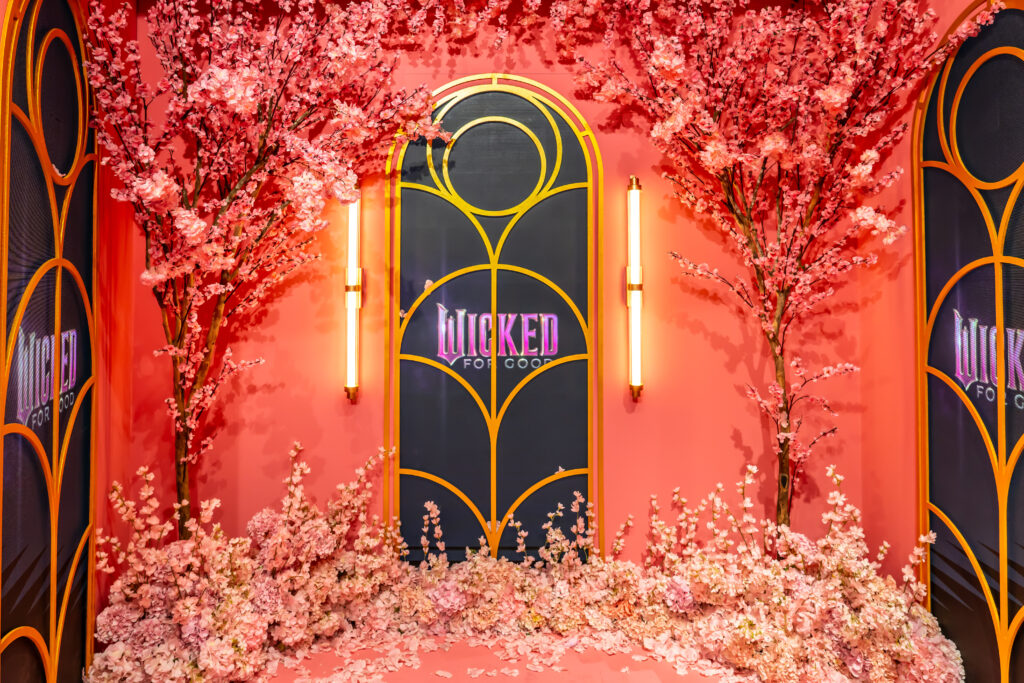
While evading the human members of the Guard with Glinda, Ms. Thropp uses an incantation that causes a broom to levitate, ultimately using said item to fly and defy capture by both human and simian members of the Guard. Here, at the climax of the film, she ends up defying the gravity of the conditions that have been thrust upon her, and powerfully pronounces:
As someone told me lately/Everyone deserves a chance to fly./And if I’m flying solo/At least I’m flying free./To those who’d ground me/Take a message back from me./Tell them how I’m defying gravity. (Chu, 2024, 2:27:56-2:28:23)
While defiantly declaring “It’s me!” (2:26:48, 2:27:46), she battles her inner demons, reunites with her inner child, and manages to liberate herself from her would-be pursuers and oppressors. What’s more, Elphaba’s literal and figurative ascent in the climax of the film–accompanied by her declaration that she is “unlimited” (2:28:50-2:29:42) and will not be brought down (2:29:55-2:30:15), preceding her final war cry–is a powerful rebuke against Madame Morrible, the Wizard, and his simian as well as human guards. This act results in her most potent manifestation yet as she affects the weather around her and blacks out the electricity throughout the entirety of the Emerald City. There is an interesting parallel to these manifestations in the parapsychological literature: despite more study being needed to determine the actual occurrence of said temperature and/or electrical effects, and while typically occurring on a much smaller scale than is demonstrated in Wicked, the manifestation (or, “manifestorium,” in Ozian speak; e.g., Chu, 2024, 2:29:25) of localized electrical disturbances and odd temperature effects (e.g., so-called cold spots; Laythe et al., 2022) is a characteristic assigned to real-life RSPK, poltergeist, and/or haunting cases.
Here, at the climax of the film, she ends up defying the gravity of the conditions that have been thrust upon her...
Conclusion
I recently attended the 2026 Anomalous Cognition and Occurrences Research Network (ACORN) Symposium in Richmond, Virginia. During the illuminating weekend, Shoshana Edelberg, PhD student of the University of West Georgia, presented her doctoral research on demonology, art therapy, and the transpersonal, commenting on the etymology of the term “demon” and how it has been subverted over time; for example, the root “daemon” refers to the genii, those guardians and protectors of treasures in the imaginal realm, who might be understood in order for a person to mature (Edelberg, 2026). The immoral nature of the demon is a more recent historical invention and attribution of the term, wherein the gods of other cultures tend to be painted as anti-structural and demonic.
I am reminded here of Paul Levy’s (2013) admonition for people to learn from rather than reject their inner daemon. For Shoshana, one illustrative example is that of Pazuzu, the antagonizing entity who plays a central role in The Exorcist. Pazuzu was not only not technically evil originally, but similar to Elphaba (self-credited as protector/purveyor of the western sky), was the spirit of the southwest wind, a powerful natural force that was to be understood and respected by the Sumerian people (Edelberg, 2026). Ms. Thropp occupies a similar exalted-then-subverted position in the Oz universe, with her nature as protectress being propagandized and twisted into something sinister rather than a force deserving of respect and restitution.
While space has not permitted in this essay, it is worth considering the interplay between the abilities of Ms. Thropp and and those of Madame Morrible in the films, as they beautifully illustrate ways in which these two women use their psychokinetic abilities for corrupt, personal gain, or for the actual (rather than feigned) betterment of the people. Taken together, both Wicked films clearly illustrate the ways in which mind-over-matter is put front and center as a means through which both subversion and synthesis are achieved.
Critically, Ms. Elphaba Thropp, our verdigrised protagonist, develops and utilizes her psychokinetic prowess in ways that are both destructuring for the people of Oz and that are restructuring for the better of all. While she is not seen this way by the majority of those with whom she interacts, our so-called Wicked Witch, along with her allies, is ultimately and truly a force for good.
Auerbach, L. (2012). William Roll: Leader in parapsychology research. Journal of Scientific Exploration, 26(2), 409-412. https://journalofscientificexploration.org/index.php/jse/article/view/483
Baum, L. F. (1900). The wonderful world of Oz. Penguin Classics.
Cardeña, E. (2015). The unbearable fear of psi: On scientific suppression in the 21st century. Journal of Scientific Exploration, 29(4), 601-620. https://journalofscientificexploration.org/index.php/jse/article/view/955
Chu, J. M. (Director) (2024). Wicked [Film]. Universal Studios.
Cutchin, J. (2020). Wildnisgeist: Poltergeist of the woods?. EdgeScience, 43, 6-13.
Edelberg, S. (2026, February 22). Demons as harbingers of spiritual emergency [Paper presentation]. Anomalous Cognition and Occurrences Research Network (ACORN) Symposium, Richmond, VA, United States.
Fawaz, R. (2025). Defying tyranny: Achieving political escape velocity with Wicked. Film Quarterly, 48(7), 61-74. https://doi.org/10.1525/fq.2025.78.4.61
Hansen, G. P. (2001). The trickster and the paranormal. Xlibris Corporation.
Hynek, J. A. (1972). The UFO experience: A scientific inquiry. Henry Regnery Company.
Laythe, B., Houran, J., Dagnall, N., Drinkwater, K., & O’Keefe, C. (w/ C. French & L. Auerbach). (2022). Ghosted!: Exploring the haunting reality of paranormal encounters. McFarland Press.
Levy, P. (2013). Dispelling wetiko: Breaking the curse of evil. North Atlantic Books.
Ferrero Sánchez, C. (2025). How is a (Wicked) witch created? Oppression and empowerment in the Land of Oz. Universidad de Valladolid.
Maguire, G. (1995). Wicked: The life and times of the Wicked Witch of the West. William Morrow Paperbacks.
Roll, W. G., & Persinger, M. A. (2001). Investigations of poltergeists and haunts: A review and interpretation. In J. Houran & R. Lange (Eds.), Hauntings and poltergeists: Multidisciplinary perspectives (pp. 123-163). McFarland Press.
Watanabe, M., & Kokubo, H. (2014). Study on macro PK with shape memory alloy and super-elastic alloy: The possibility of non-professional scientists. Journal of International Society of Life Information Science, 32(1), 16-33. https://www.jstage.jst.go.jp/article/islis/32/1/32_KJ00009281557/_pdf
Williams, B. J. (2012). The psychical research foundation and its legacy under William G. Roll: Past findings and future directions [Invited talk]. Psychical Research Foundation. https://tinyurl.com/bdz3sv67
Yusupova, J. A. (2026). Spirit photography: The ghosts of Salem. Mindfield: Bulletin of the Parapsychological Association, 17(3). https://mindfieldbulletin.org/spirit-photography-the-ghosts-of-salem/


In this issue of Mindfield, the contributors examine the theme of “Mapping the Unseen: Psi, Media, and the Cultural Imagination.” The editorial by Jacob W. Glazier, Anastasia Wasko, and David S. B. Mitchell examines how fictional narratives can create the cultural space in which new scientific ideas and research agendas emerge. In his Presidential Column, …

by Carl Lorenz Cervantes