by Gerhard Mayer, 2026 Presidential Address



by Gerhard Mayer, 2026 Presidential Address
In April 2024, I was invited to participate in a workshop on the philosophy of science titled “Gatekeeping in Science,” which was held at the University of Innsbruck in Austria. Surprisingly, one of the organizers, the philosopher Katherine Dormandy, saw value in presenting the challenges faced by parapsychology and anomalistics within the scientific community as an example of scientific gatekeeping.
I went to Innsbruck in a curious state of mind, but not intellectually unbiased, burdened by my experiences with gatekeeping that most parapsychologists are familiar with: the general disqualification and ridiculing of one’s own work as pseudoscience, for example, by the well-known physicist and philosopher Gerhard Vollmer (“Parapsychology is a pseudoscience,” Vollmer, 2017, p. 87). For many workshop participants, anomalistics was unfamiliar, and for some it will likely remain so, as they failed to see the relevance of this small and under-resourced discipline to science at large. Be that as it may, I enjoyed a stimulating exchange in a very hospitable atmosphere.
The insights gained during the workshop were to be published in a special issue of a philosophy journal. Katherine Dormandy encouraged me to submit my contribution as well—even though it would not be easy due to the rigorous review process. I accepted the challenge, wrote a detailed paper, and sent the draft for preliminary assessment to Katherine. I received very constructive and helpful feedback from her. She pointed out sections where I would likely encounter incomprehension among a philosophically skeptical and—in terms of parapsychology—uninformed readership, where my tone was inappropriate, where further explanation was required, and so on. I sent a revised draft for preliminary review. There were still passages that she considered problematic in terms of a proper evaluation by skeptical philosophers. To make a long story short: After several rounds of additions, streamlining, linguistic revisions, and finally the suggestion to split the increasingly lengthy essay into several parts, I decided not to submit it to the collection due to deadline constraints. I also questioned whether it was worth the effort to convince philosophers of the value of parapsychological research.
I also questioned whether it was worth the effort to convince philosophers of the value of parapsychological research.
Yet all that tiptoeing around on eggshells, and the work that went into the article, were not entirely in vain. Thanks to Katherine’s admirable patience and critical eye, I have learned to sharpen my sense of language and argumentation and to better adopt a skeptic’s perspective. I have also gained a more nuanced understanding of why the concept of pseudoscience matters to many philosophers of science and scientists, and how they use it for demarcation.
Parapsychologists and the Accusation of Pseudoscience
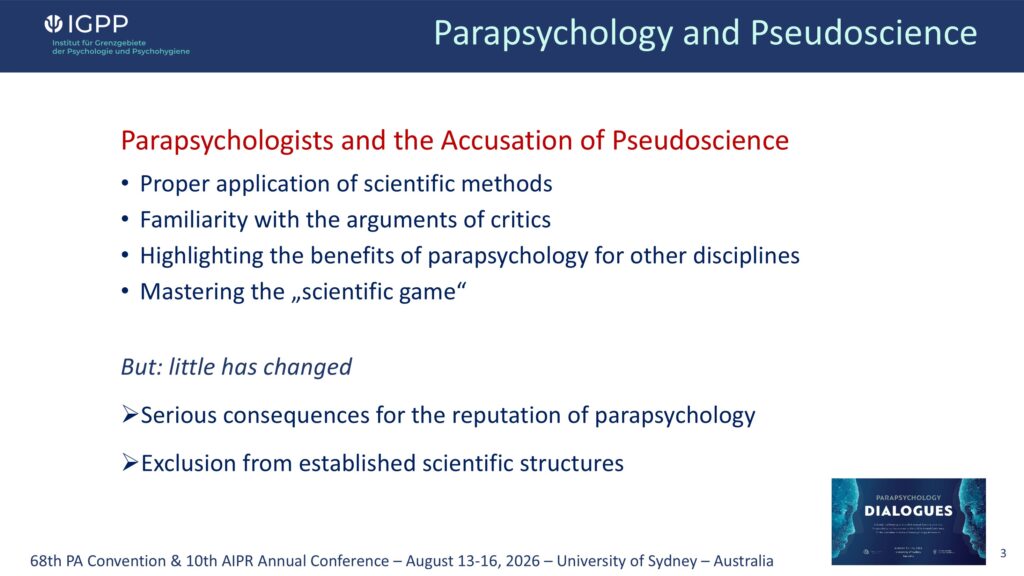
Among the common responses from parapsychologists to the accusation that they are engaging in pseudoscience are attempts to demonstrate the proper application of scientific methods, to show familiarity with their critics’ arguments and acknowledge the valid ones, to highlight the benefits of parapsychology for other scientific disciplines, and to emphasize that it has mastered the “scientific game,” that is, the rules of scientific practice as a social institution.
However, after many years of successful parapsychological experiments, methodological innovations (Hövelmann, 2015), and an undeniable positive body of evidence (Cardeña, 2018), as well as science policy efforts (e.g., Dean, 2016), surprisingly little has changed in the scientific and public reception of parapsychology. The dismissal as pseudoscience is still common.
This has serious consequences for its reputation, as the label “pseudoscience” creates the impression that no further knowledge of parapsychology is needed to form a well-founded opinion. As a result, critics are often unfamiliar with the relevant research literature or choose to ignore it (Sommer, 2014). Exclusion from established scientific structures such as journals, conferences, etc. and from government-funded research opportunities are among the most serious consequences. The renowned physicist John A. Wheeler, for example, called at the 145th National Meeting of the American Association for the Advancement of Science (AAAS) for the expulsion of the Parapsychological Association from the AAAS: “The decade of permissiveness is now well past so it is time to drive the pseudos from the workshop of science” (O’Toole, 1979). To better understand this process of demarcation, it is useful to take a closer look at the concepts and use of the term “pseudoscience.”
Pseudoscience—Problematic Definitions
There have been numerous attempts to define the term “pseudoscience,” yet this has proven to be a difficult task—a task on which many philosophers have already cut their teeth (Hagner, 2008, p. 21). The author of the book Pseudoscience and the Paranormal, Terence Hines (2003), writes, for example, “a pseudoscience is a doctrine or belief system that pretends to be a science” (p. 1). And in William S. Williams’ (2000) introductory chapter “Science or Pseudoscience” to the Encyclopedia of Pseudoscience: From Alien Abductions to Zone Therapy, we can read: “All pseudoscience is irrational; that is, it disregards or contradicts rational principles” (p. xix).
In most attempts to define pseudoscience this is done—directly or indirectly—in relation to the specific field of research or subject matter. The criterion in these cases is not whether a subject of research can be scientifically investigated—which would not be the case for metaphysical statements of belief—but whether it is considered sensible or senseless to deal scientifically with such a subject. Therefore, engaging in senseless research is regarded as irrational behavior and a futile undertaking, and is thus defined as pseudoscience.
However, the question of which research is classified as “irrational” and which as rational depends basically on scientists’ individual assessments of what they consider possible or impossible in terms of a priori probability, or on the uncritical adoption of a majority opinion. These assessments undermine the methodological arguments—namely, that parapsychologists possess the tools and employ the techniques necessary for excellent science. For, as skeptical critics argue, even the best research methodology and its correct application are worthless if applied to the “wrong” research subject. Worthless, or even dangerous. I’ll come back to that later.
In addition to defining pseudoscience as a practice based on irrational beliefs, there are other concepts of pseudoscience. Nikil Mukerji and Edzard Ernst have distinguished it from related concepts, namely “parascience” (not necessarily claiming to adhere to the rules of science), “protoscience” (a potential precursor of real science), “bad science,” and “science fraud” (Mukerji & Ernst, 2022).[1] To define “pseudoscience,” they refer to James Ladyman, who equates scientific fraud with lies and pseudoscience with “bullshit.” Ladyman acknowledges, however, that ordinary bullshitters usually “know what they are doing whereas… many pseudoscientists are apparently genuinely seeking truth” (Ladyman, 2013, p. 52). Mukerji and Ernst address this problem by writing: “these pseudoscientists go so far as to bullshit themselves” (Mukerji & Ernst, 2022, p. 394).
The typical criteria used by critics of parapsychology to characterize pseudoscience are summarized as follows: (1) it deals with unfalsifiable or irrefutable hypotheses; (2) it is unwilling to look closely at the phenomena or the evidence; (3) it does not adhere to scientific standards; (4) it disregards rational principles; (5) it is based on an unacceptable or wrong belief system or doctrine; and (6) it pretends to be science by imitating scientific procedures without any real understanding.[2] All these criteria—when considered with due regard for the relevant research literature—cannot be applied to parapsychology. It is above all the controversial point 5—namely, the accusation that parapsychologists adhere to a supposedly false belief system by considering psi phenomena possible—upon which parapsychology’s fiercest critics rely.[3] I will come to this later.
Both the prefix “pseudo-” and the comparison with “bullshit” demonstrate that the term “pseudoscience” is normatively charged. All definitions share one common feature: the term serves as a demarcation, is always applied to others with pejorative intent, and is used as a political battle term (Hagner, 2008). Due to this rationale behind its usage and the lack of definitional precision, philosopher of science Philip Kitcher writes, “There is no single, unambiguous characteristic capable of clearly distinguishing science from pseudoscientific doctrines” (2008, p. 430, translated by author).[4] His colleague, Larry Laudan, states: “If we would stand up and be counted on the side of reason, we ought to drop terms like ‘pseudo-science’ and ‘unscientific’ from our vocabulary; they are just hollow phrases which do only emotive work for us” (Laudan, 1983, p. 125). Given the reasons for its use and the lack of conceptual precision, there are compelling arguments for avoiding this term altogether.
I would generally agree with that. However, I have found one useful definition of “pseudoscience” and will present it after some preliminary considerations.
Science as a Symbolic Form of Understanding the World
What is science? According to the definition of the Encyclopedia Britannica, science is “any system of knowledge that is concerned with the physical world and its phenomena and that entails unbiased observations and systematic experimentation. In general, a science involves a pursuit of knowledge covering general truths or the operations of fundamental laws” (The Editors of Encyclopaedia Britannica, n.d., para. 1).
The definition of Wikipedia calls science “a systematic discipline that builds and organises knowledge in the form of testable hypotheses and predictions about the universe” (Science, n.d., para. 1). “A system of knowledge,” “a discipline, building and organizing knowledge”—such definitions emphasize the existence of an objectively given reality that can be grasped using the “scientific method.” These notions presuppose a physicalist model of reality and determine the dominant idea in Western cultures of what science is. However, this has relatively little to do with the scientific practice within its social context. In addition to being viewed as a social enterprise, science can be understood as a language game in the Wittgensteinian sense, thereby demonstrating that meaning is socially produced, regulated, and learned, rather than being an implicit component of a context-independent and objectively given physical reality.
I will present another approach, a largely forgotten but useful conception by the German philosopher Ernst Cassirer (1874–1945), who understands science as a “symbolic form” (Cassirer, 1944). It is very helpful when addressing the demarcation problem. The common ground with Wittgenstein’s approach lies in the fact that science is not understood as a mere representation of an independent pre-existing reality, but rather as a symbolic or rule-governed practice. In Cassirer’s view, humans—as symbolic animals—try to understand the world by creating a universe of symbolic meanings. Perception of the world is therefore never merely receptive, but, due to the necessity of symbolization, always actively formative as well. This also applies to science, which is only one of many ways to understand the world—alongside others such as art, myth, religion, history, and language. The scientific approach concerns the general, such as orders, patterns, and regularities, while it disregards singularities. In contrast, the artistic approach concerns the individual, the singular, and the unique.
Science as a symbolic form of understanding the world can be considered in terms of its results—e.g., an unprecedented degree of permanence and stability in our models of the world. That which is changeable and subjectively experienced was abstracted and classified within a framework of universally applicable laws and classification systems. Time and space lost their qualitative character and became abstract, homogeneous, and quantitatively operable parameters. With such an approach, the individual is of interest only in relation to the average—namely, as a manifestation of the general (tainted by deviations)—and not in its uniqueness and singularity.
However, science as a symbolic form can also be interpreted as a fundamental human activity.
However, science as a symbolic form can also be interpreted as a fundamental human activity. As the example of pareidolia shows, our sensory and cognitive systems are geared toward recognizing objects, patterns, and meaning in ambiguous stimuli. Likewise, the scientific approach to the world—the search for regularities, the creation of systems of order, and the experimental testing of their reliability—is inherent in our cognitive apparatus and natural behavioral repertoire. It provides a sense of permanence and stability in our perception of the world. Transforming perceptions into information and integrating them into a system of order to generate meaning and a model of the world is as much a part of being human as digestion or the need for aesthetic perception or creation in whatever form. One can adapt the statement by the German artist Joseph Beuys, “Every human being is an artist,” to say, “Every human being is a scientist.”
Engaging in scientific work does not automatically mean subscribing to the rationality that characterizes Western science, or adhering to a materialistic-physicalist worldview.
Science can therefore be good or bad, better or worse adapted to the realities of a given situation—which also depends on the relevant ideological and cultural framework—but “pseudoscience” in its common use would be a nonsensical term.
How can we Make Sense of the Term “Pseudoscience”?
In contemporary academia, criteria for the qualitative assessment of science are sufficiently available. Some may change over time, and new ones may be added. There are, for instance, overviews on “questionable research practices” that are very helpful for distinguishing between good and bad science in less obvious details. Why is that not enough for qualitative evaluation and differentiation? Why do scientists and philosophers have such a hard time abandoning the use of the term “pseudoscience”—which, incidentally, also applies to parapsychologists?
The meaning of the prefix “pseudo,” derived from the Ancient Greek word pseudes (false, deceitful) or pseudos (deception, lie), indicates that something is not real, but only exists in appearance. One way of its interpretation is to view the relationship between pseudoscience and science as analogous to that between glossolalia (speech-like, or “as-if” language) and a real language—“as-if” science vs. real science.
As parapsychologists, we encounter this term much more frequently with a different meaning: pseudoscience is science that deceives (not “as-if” science), with the deception in parapsychology lying in the fact that its scientific endeavors are allegedly based on irrational ideological assumptions (=self-bullshitting). The more convincingly such “misleading” science is presented, the more dangerous critics consider it. Through this practice, “false” or “irrational” beliefs are refined by scientific methods and take on the appearance of truth. For these critics, the issue is not the quality of the science but the acceptance of its underlying ideological assumptions. Because of its worldview-dependent use, the term “pseudoscience” should be rejected in this context.
But the aforementioned aspect of deception leads to an apt definition of pseudoscience used by Katherine Dormandy and Bruce Grimley (2024). Here, the aspect of deception, or deceit, does not refer to the ideological assumptions critics reject, but to the goals for which scientific practice is used. The ideal aim of science is to generate knowledge through scientific methods. However, there are cases in the history of science where these methods have been used to prevent knowledge acquisition. One example is tobacco industry-funded research that sought to obscure or delay the recognition of a causal link between smoking and lung cancer (Oreskes & Conway, 2010). In such cases, the term “pseudoscience” is appropriate because the goal is not to gain knowledge but to hinder it. This can be achieved through obstructing publications or funding, or by presenting the literature in a selective and biased way to support preferred theories. Politically motivated efforts to spread disinformation through scientific channels on issues such as climate change, environmental pollution, or race follow a similar pattern. It becomes pseudoscience—and this is where the term is appropriate—when it is pursued for non-scientific purposes in defiance of better knowledge. Admittedly, however, it is often difficult to determine whether such politically motivated or value-driven dissemination of disinformation actually takes place against one’s better judgment. Kevin Elliott’s (2017) excellent book A Tapestry of Values discusses the topic of values in science in great depth.
As an activity carried out by social beings, science often contains a certain degree of pseudoscience; i.e., personal motives play a role—motives that do not aim at the mere acquisition of knowledge, but rather, for instance, at advancing one’s own career through an embellished presentation of research results—thereby hindering the advancement of knowledge through the use of scientific means. Here, too, it is sometimes difficult to draw the line between these forms of pseudoscience and wishful thinking or confirmation bias (=bad science).
However, this use of the term “pseudoscience” has little to do with the criticism that parapsychology repeatedly faces on the grounds of allegedly irrational basic assumptions.
Why is There such Insistence on Using the Term “Pseudoscience”?
I would like to revisit the question raised earlier: Why do scientists and philosophers have such a hard time abandoning the use of the term “pseudoscience”? We can find hints in a paper with the remarkable title “On the Value of Pseudoscience and its Philosophical Study” by Adam Tamas Tuboly (2025). The introduction begins as follows:
If taken in the most general way, pseudoscience and pseudoscientific theories have two major characteristics: They are dangerous and persistent. The pseudosciences are dangerous because they can easily lead to public health crises (like AIDS denialism or anti-vaccination campaigns) or contribute to false and misleading beliefs about the fundamental structure of the world (like Flat-Earth Theory). Consequently, they could also undermine public trust in genuine scientific theories. (p. 1, emphasis in original)
After the author clarifies right at the outset just how dangerous it is to engage with pseudosciences from a scientific or philosophical standpoint, the article proceeds with a well-reasoned and informative discussion, before he reiterates toward the end his warnings:
This is indeed a delicate matter. On the one hand, the theory to be inoculated against must be strong enough to stimulate engagement with it and prompt an interest in refuting it. On the other hand, the pseudoscientific theory shouldn’t be too strong, and its points and arguments should not be too precise, convincing, and engaging, because otherwise, people might end up being convinced by it. For such cases, philosophy could perhaps provide a nuanced perspective that is abstract enough to avoid dangerous levels of engagement… (p. 25)
In a footnote, Tuboly refers to Harry Collins and Trevor Pinch’s study on parapsychology (Collins & Pinch, 1982) as an example of the looming dangers:
If one aims to understand something (in this case parapsychology, or any other pseudoscientific theory), then understanding requires a certain amount of concrete and deep engagement with the subject, but that carries with it the danger that over time one will see the others’ reasons as good reasons and thus fall prey to the theory. (p. 25)
A curious and absurd line of reasoning, since the author is essentially saying that there is a risk that, upon closer inspection, one might realize that a supposedly pseudoscientific theory is not actually pseudoscientific. And that must be avoided. The proximity to theological debates—specifically the risk of falling away from the true faith by engaging too closely with the positions of its enemies—becomes evident here.
The fundamental driving force is to prevent science from being misused to promote dangerous ideologies. An understandable and reasonable request. The societal risks posed by AIDS and COVID-19 denial, as well as the rejection of global warming and environmental pollution, are evident. However, it is difficult to see how this applies to parapsychology. Here, concerns focus on the potential erosion of “public trust in genuine scientific theories.” Yet it is difficult to demonstrate that distrust of science and conventional medicine originates primarily from alternative healing methods or worldviews; missteps and scandals within mainstream science, along with broader distrust of state institutions, are likely more significant factors. Moreover, the attempt to enforce the doctrine of a unified science—arguably underlying the notion of “genuine scientific theories”—can itself be viewed as ideologically problematic.
At the Heart of the Matter
If we look at the recent history of the demarcation problem—a period in which it increasingly came to bear upon parapsychology as well—we find one prominent theory at the heart of the controversy: that of creationist science. Research approaches that called into question the general validity of established evolutionary-biological principles and offer alternative hypotheses should be kept out of science by any (philosophical) means necessary. The philosopher of science, George A. Reisch, wrote: “I will argue here that unity should be upheld as an ideal for science and, in addition, that the demarcation problem should be reframed as a scientific problem” (Reisch, 1998, p. 344). It is not philosophy, but science itself, that is responsible for determining where the boundary between science and non-science lies:
If scientists were to become interested in creation-science then, according to this proposal, it would count as genuine science. This inference is correct, but it does not count as an objection. Most, if not all, scientists are disinterested in creation-science (except, perhaps, as an anti-scientific social phenomenon). That is the practical and legal strength of this approach. Even if scientists of the future were to convert to creation-science, it presents a problem now, and this approach provides us tools to frame and manage that problem, now. (p. 347, emphasis added)
To achieve the ideal of a unified science—as a central objective drawn from the programmatic agenda of logical empiricism—has now been placed in the hands of science itself. Its foundation, intended to encompass all subdisciplines including humanities, is to be physicalism. Ideological pluralism not only jeopardizes the project of a unified science, but is “failing to supply strategies for demarcating science from non-science” (Reisch, 1998, p. 333). The goal in this case was to keep theories or models critical of evolutionary theory out of the scientific community—in other words, classic gatekeeping.
One could view the attacks against parapsychology as collateral damage in the fight against creationism, but that would be too simplistic. Just as creationism challenges the general validity of the conventional evolutionary model, parapsychology, with its unusual findings, challenges reductionist physicalism. And the gateway for potentially metaphysical elements is similarly wide open here. The key difference is that creationism reached the doorstep of American classrooms, provoking strong reactions from philosophers and scientists, whereas parapsychology, because of its marginal status, was and remains far removed from any comparable influence.
Otto Neurath (1882–1945), an Austrian-born philosopher of science and one of the leading figures of the Vienna Circle of logical empiricism, who led the unity of science movement, provided a thought-provoking metaphor for the situation of philosophers of science. He wrote: “We are like sailors who have to rebuild their ship on the open sea, without ever being able to dismantle it in a dry-dock and reconstruct it from the best components” (Neurath et al., 1983, p. 92). This metaphor, tinged with disillusionment, may run deeper than its creator perhaps intended. Logical empiricism does not like a situation where “there is no way to establish fully secured, neat protocol statements as starting points of the sciences” (Neurath et al., 1983, p. 92).

The situation necessitating the repair of a vehicle while it is in motion precludes a perfect fundamental renewal, such as would correspond to the philosophical ideal underlying a unified science. However, it is the existential dimension of the ship—situated on a shifting surface, on the high seas, upon the unknown and unpredictable ocean—that lends the image its sense of depth.
The goal of science is to create stability and consistency in our experience of the changing world. Underlying the desire for a unity of science is the notion that there can be only one structure capable of providing this stability in perfection… and that we have solid ground beneath our feet. Yet our models are like ships on the ocean, not in dry dock.
Metaphorically speaking, the elusive properties of psi phenomena—with their trickster-like quality—represent the lack of firm ground with which human beings must epistemologically contend. The replication problem and other peculiarities such as experimenter effects compel parapsychologists to undertake theoretical and methodological efforts that—to stick with the ship metaphor—do not regard the fluid, unfixed element of the ocean as a disruptive factor that makes them yearn for the safety of a dry dock, but rather try to integrate as far as possible into their models of reality.
Parapsychology, Pseudoscience, Anti-Science
Coming to a close, I would like to revisit the appropriate use of the term “pseudoscience,” discuss its connection to parapsychology, and clarify how it differs from “anti-science.”
If the most fundamental goal of science is to gain knowledge about the world through scientific means, then the use of scientific methods to prevent the acquisition of knowledge can reasonably be described as pseudoscience, or—using a better, less misleading term—deceptive or deceitful science. In prominent cases—such as the deployment of scientific expertise in the service of the tobacco industry—this is plainly evident. At a lower level, we find elements of pseudoscience in parapsychology as well, just as we do everywhere else in science. If a scientist, against their better judgment, suppresses inconvenient findings to promote their own position or favored theory, this aspect of their behavior should be regarded as pseudoscientific.
According to this definition, the three skeptics, Stuart Ritchie, Richard Wiseman and Chris French, who failed to replicate Daryl Bem’s findings of his presentiment experiments, did not engage in pseudoscience because they conducted a parapsychological experiment. However, if they already knew—prior to the publication of their study “Failing the Future”—that there were other replications of the Bem experiments yielding confirmatory results, then the failure to disclose this information would have to be classified as pseudoscientific behavior.
When we turn our attention to the notorious response by the two skeptics, Arthur Reber and James Alcock, to Etzel Cardeña’s review article on the current state of experimental parapsychological research in the American Psychologist (Cardeña, 2018), a very different picture emerges. Reber and Alcock write in their rebuttal: “Parapsychology has failed to demonstrate that its claimed phenomena actually exist… Claims made by parapsychologists cannot be true. The effects reported can have no ontological status; the data have no existential value” (Reber & Alcock, 2020, p. 391). In another article on this topic, they confess: “We did not examine the data for psi… Our reason was simple: the data are irrelevant” (Reber & Alcock, 2019, p. 8).
This is not pseudoscience, but anti-science. Here, scientific knowledge is not hindered by scientific means, but by beliefs that purposefully disregard empirically obtained scientific data. We are familiar with such disregard for empirical observations, from historical examples, e.g., from Galileo Galilei, who stated: “In spite of my oft-repeated efforts and invitations, they have refused, with the obstinacy of a glutted adder, to look at the planets or the Moon or my glass [telescope]” (as cited in Mackay & Medawar, 1991, p. 99); or as historian Ursula Marvin describes the scientific approach to meteorites in the 18th century: “So, if no stones were up there, no stones could fall… Occasional reports of fallen stones were not to be believed because they always came from ignorant country people” (Marvin, 2006, p. 34). Or, more recently, when Jule Eisenbud’s academic colleagues refused to participate as observers in his “thoughtography” experiments with Ted Serios, and he was told: “Honestly, I don’t think I should take part in these experiments” (Eisenbud, 1989, p. 312).
Concluding Considerations
One final question remains to be answered: Why should any of this matter to us parapsychologists? Why not simply carry on and say: “Let them think about us whatever they want—we are doing our job as best we can.”
If it were really just about convincing critics, I would agree. These considerations are, however, also valuable in terms of self-reflection and self-positioning. We should not allow our fascination with the topics of our research to mislead us on this point, for that could lead us to limit ourselves. If we follow the critics of parapsychology and define the field solely by its subject matter—that is, as the branch of science concerned with the phenomena of ESP, PK, and precognition—then we are voluntarily putting ourselves in the straitjacket that our critics have placed us in. But if we primarily view ourselves as scientists doing what all scientists do—namely, using scientific methods to search for patterns and order within our reality—then our own perspective on the research subject can also change on a theoretical level. This is evident, for example, in the work of Prof. Markus Maier’s research group in Munich/Germany, where, in the search for data anomalies based on generalized quantum theory, classical parapsychological terms usually associated with psi phenomena, such as ESP and psychokinesis, do not appear at all.
If it were really just about convincing critics, I would agree. These considerations are, however, also valuable in terms of self-reflection and self-positioning.
There are indications that the subject matter of parapsychology is undergoing—and indeed should undergo—a redefinition, and that the boundaries within anomalistics are gradually becoming blurred, just as they were in the early days of the Society for Psychical Research. Some traditionally oriented parapsychologists may be unsettled by this, yet great opportunities lie in the broadening of the horizon.
[1] Parascience “may claim… to possess a superior way of knowing that is preferable to science. To the extent that parascientists show disdain for science, they may also be categorised as anti-scientists… Protoscientists seek to practice science but have not been able, because of a lack of time or resources, to establish their scientific credentials” (Mukerji & Ernst, 2022, p. 6-7 of 29). “James Ladyman thinks that ‘pseudoscience is,’ in a first approximation, ‘to science fraud as bullshit is to lies’” (Mukerji & Ernst, 2022, p. 8 of 29).
[2] Other elements could be added to this list, but they would not make the picture any clearer. Radner and Radner (1982), for example, cite the following as further “marks of pseudoscience:” anachronistic thinking, looking for mysteries, appeal to myths, the grab-bag approach to evidence, irrefutable hypotheses (already on the list above), argument from spurious similarity, explanation by scenario, research by exegesis, and refusal to revise in light of criticism (already on the list above).
[3] See, e.g. Sommer, 2014, for some historical examples.
[4] See also Noakes (2025) and Tuboly (2025).
Cardeña, E. (2018). The experimental evidence for parapsychological phenomena: A review. The American Psychologist, 73(5), 663–677. https://doi.org/10.1037/amp0000236
Cassirer, E. (1944). An essay on man: An introduction to a philosophy of human culture. Yale University Press.
Collins, H. M., & Pinch, T. J. (1982). Frames of meaning. The social construction of extraordinary science. Routledge & Kegan.
Dean, E. D. (2016). Parapsychology is now a recognized science: How it was done. Mindfield: The Bulletin of the Parapsychological Association, 8(2), 48–53.
Dormandy, K., & Grimley, B. (2024). Gatekeeping in science: Lessons from the case of psychology and neuro-linguistic programming. Social Epistemology, 38(3), 392–412. https://doi.org/10.1080/02691728.2024.2326828
Eisenbud, J. (1989). The world of Ted Serios: “thoughtografic” studies of extraordinary mind (2nd ed.). Morrow.
Elliott, K. C. (2017). A tapestry of values: An introduction to values in science. Oxford University Press.
Hagner, M. (2008). Bye-bye science, welcome pseudoscience? Reflexionen über einen beschädigten Status. In D. Rupnow, V. Lipphardt, J. Thiel, & C. Wessely (Eds.), Pseudowissenschaft (pp. 21–50). Suhrkamp.
Hines, T. (2003). Pseudoscience and the paranormal (2nd ed.). Prometheus Books.
Hövelmann, G. H. (2015). On the usefulness of parapsychology for science at large. In E. Cardeña, J. Palmer, & D. Marcusson-Clavertz (Eds.), Parapsychology: A handbook for the 21st century (pp. 389–398). McFarland & Company, Inc.
Ladyman, J. (2013). Toward a demarcation of science from pseudoscience. In M. Pigliucci & M. Boudry (Eds.), Philosophy of pseudoscience: Reconsidering the demarcation problem (pp. 45–60). University of Chicago Press. https://doi.org/10.7208/chicago/9780226051826.001.0001
Mackay, A. L., & Medawar, P. B. (1991). A dictionary of scientific quotations (2nd ed.). Institute of Physics.
Marvin, U. B. (2006). Meteorites in history: An overview from the Renaissance to the 20th century. In G. J. H. McCall, A. J. Bowden, & R. J. Howarth (Eds.), The history of meteoritics and key meteorite collections: Fireballs, falls and finds (pp. 15–71). Geological Society.
Mukerji, N., & Ernst, E. (2022). Why homoeopathy is pseudoscience. Synthese, 200(5), Article 394. https://doi.org/10.1007/s11229-022-03882-w
Neurath, O., Cohen, R. S., & Neurath, M. (1983). Philosophical papers 1913-1946: With a bibliography of Neurath in English. Springer. https://doi.org/10.1007/978-94-009-6995-7
Noakes, R. (2025). Was the paranormal good for physics? Nature Reviews Physics, 7(2), 66–67. https://doi.org/10.1038/s42254-025-00805-9
Oreskes, N., & Conway, E. M. (2010). Merchants of doubt: How a handful of scientists obscured the truth on issues from tobacco smoke to global warming. Bloomsbury.
O’Toole, T. (1979, January 9). Scientists’ group is urged to oust parapsychologists. The Washington Post. https://www.washingtonpost.com/archive/politics/1979/01/09/scientists-group-is-urged-to-oust-parapsychologists/d81a89ef-788a-4c61-a7c4-6821a8648964/
Radner, D., & Radner, M. (1982). Science and unreason. Wadsworth.
Reber, A. S., & Alcock, J. E. (2019). Why parapsychological claims cannot be true. Skeptical Inquirer, 43(4), 8–10.
Reber, A. S., & Alcock, J. E. (2020). Searching for the impossible: Parapsychology’s elusive quest. American Psychologist, 75(3), 391–399. https://doi.org/10.1037/amp0000486
Reisch, G. A. (1998). Pluralism, logical empiricism, and the problem of pseudoscience. Philosophy of Science, 65(2), 333–348.
Science. (n.d.). In Wikipedia. Retrieved October 9, 2026, from https://en.wikipedia.org/wiki/Science
Sommer, A. (2014). Psychical research in the history and philosophy of science: An introduction and review. Studies in History and Philosophy of Science Part C: Studies in History and Philosophy of Biological and Biomedical Sciences, 48, 38–45. https://doi.org/10.1016/j.shpsc.2014.08.004
The Editors of Encyclopaedia Britannica. (n.d.). Science. Encyclopaedia Britannica. https://www.britannica.com/science/science
Tuboly, A. T. (2025). On the value of pseudoscience and its philosophical study. European Journal for Philosophy of Science, 15(3), Article 43. https://doi.org/10.1007/s13194-025-00672-2
Vollmer, G. (2017). Gretchenfragen an Naturalisten (Zweite, erweiterte Auflage). Alibri.
Williams, W. F. (2000). Science or Pseudoscience? In W. F. Williams (Ed.), Encyclopedia of pseudoscience: From alien abductions to zone therapy (pp. xviii–xx). Facts on File.

In this first of a double issue of Mindfield Bulletin on “Clinical Approaches for Exceptional Experiences in Children and Adolescents,” Gerhard Mayer contributes his 2026 Presidential Address, arguing that parapsychology is often unfairly labeled as pseudoscience and contends that the term should be reserved for scientific practices that intentionally obstruct or distort knowledge rather than …
by Gerhard Mayer, 2026 Presidential Address