by Leo Ruickbie




by Leo Ruickbie
The kitchen was a mix of Victorian practicality and castle dungeon, thick stone walls with a clinical whitewash, a deep red, ox-blood floor, a long wooden table like a rack in the center, copper pots glittering from their hooks in the dim lighting. It was the first stop on our tour of Crathes Castle led by a jovial man in a kilt, and the large, talkative gaggle of academics had some difficulty squeezing in.
“This kitchen is said to be haunted by the ghost of…”
“A little girl.”
We turned to look at the woman who had spoken: black dress, black Cleopatra hairstyle, serious expression. She told us she was psychic. We were inclined to believe her.
“She’s over there.”
We turned to where she was looking. A nondescript corner suddenly imbued with supernatural intrigue.
“Ah, well, yes.” The tour guide sounded less jovial. A well-rehearsed line in his tour guide’s spiel was taking on a life, or an afterlife, of its own. He also looked.
“She doesn’t know she’s dead,” and our psychic started to tell us about her. We listened intently. The tour guide looked put out. It was his tour, after all.
“I can help her to move on, to go into the light.” She looked at the tour guide.
“Ah, well, no, I mean…” The tour guide looked panicked. You could see him wrestle internally with the problem: On the one hand, here was a valuable asset for castle tourism; on the other, here was a soul potentially trapped in the physical realm for the entertainment of strangers for all eternity.
As he dithered, she went ahead anyway, speaking to the supposed spirit of the little girl, reassuring her and guiding her on to whatever lay beyond.
As castle tours go, we had gotten off to a very uncanny start, and we had not even reached the infamous Green Lady’s room yet.
Crathes Castle sits in picturesque grounds, buried in woodland in the Aberdeenshire countryside, and our tour had been specially arranged with the owners, the National Trust for Scotland, by Dr. Rachael Ironside as part of the conference “The Supernatural in Contemporary Society.” And now, suddenly, we were not just talking about it, but experiencing it firsthand, goosebumps, shivers and all.
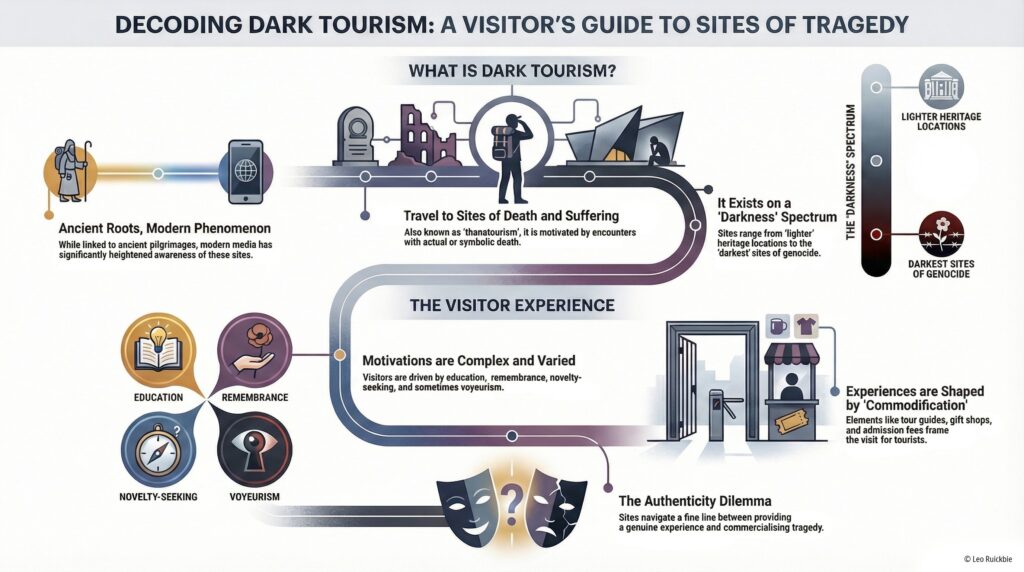
Coined by Foley and Lennon in 1996, dark tourism is defined as the act of visiting sites associated with death, disaster, and suffering (Foley & Lennon, 1996). These places range from historical battlegrounds and prisons to sites of natural and man-made disasters and miscellaneous tragedies. Researchers have identified various categories within dark tourism, including sites of individual or mass deaths, memorials, and symbolic representations of death.
Was this what I was doing? Had I become an accidental dark tourist? In The Accidental Tourist, the protagonist becomes an unwilling participant in encounters that unsettle his emotional orientation to the world. This is emphasized in Lawrence Kasdan’s (1988) adaptation of Anne Tyler’s (1985) novel; Macon Leary travels reluctantly, seeking to minimize disruption yet repeatedly finding himself altered by unplanned emotional entanglements. My trajectory on the conference circuit mirrored this dynamic: Professional travel placed me in proximity to sites connected to the supernatural, drawing me into forms of dark tourism that I would otherwise not have had the opportunity to explore. The parallel lies in how unintended itineraries produced forms of self-confrontation—emotional in the film, epistemic and historiographical in my case—revealing that the most transformative journeys often unfold not by design but through happenstance. By arriving as a researcher—with particular questions, disciplinary habits, and interpretive frameworks—I found myself engaged in a form of unintentional auto-ethnography in which the scholar becomes part of the story, demonstrating that even accidental engagements can recalibrate one’s understanding of place, memory, and haunting. By subsequently writing about and publishing articles illustrated with my photographs of these places, I became entwined in their narratives, refreshing, reproducing, and sometimes reorienting them. Through it all, I had, quite accidentally, wandered into an academic category.
I found myself engaged in a form of unintentional auto-ethnography in which the scholar becomes part of the story...
Diary of a Dark Tourist
From the year of my first conference with the Society for Psychical Research (SPR) in 2014 to just before COVID hit in 2019 and the world came to a standstill, the conference circuit took me from a ghost walk in Cambridge to the reputedly haunted Jack the Ripper Museum in London via the Paris Catacombs and the current claimant to the title of “most haunted house in England” in Pontefract, amongst other places. As a relatively new member of the Society since 2012, I had already published two books with Robinson in their “Brief Guide” series: A Brief Guide to the Supernatural (Ruickbie, 2012) and A Brief Guide to Ghost Hunting (Ruickbie, 2013); neither was particularly brief, but they had prepared me for my journey.
My journey began in March 2014 in Cambridge, where, with winter’s chill still clinging to her dreaming spires, academics from around the world gathered for “Visions of Enchantment” at the University. I was there with my wife, Dr. Antje Bosslemann-Ruickbie, presenting on the symbolism of witchcraft while she spoke on Byzantine magical amulets (Bosselmann-Ruickbie, 2019; Ruickbie, 2014a, 2019a). A cozy pub offered a safe refuge to meet Alan Murdie, President of the Ghost Club and Chair of the SPR’s Spontaneous Cases Committee (the Society’s investigative arm), before he led us on a tour of the town’s reputedly haunted spots. There were few people out on the streets that night as Murdie regaled us with his best Cambridge ghost stories, breath fogging in the air and footsteps echoing off the cobbles, as our route took in Trinity College, Corpus Christi, Peterhouse, and the city’s pubs and churchyards, all suffused with a supernatural aura (Halliday & Murdie, 2010).
Cambridge was an eminently suitable place to start legend-tripping on the conference circuit. Whilst an undergraduate at Trinity College, mathematician Charles Babbage and some fellow students had formed a “Ghost Club” around 1810-1812—this, or perhaps another, Trinity ghost club was still being talked of up until 1851—and several Fellows of Trinity would form the core of the Society for Psychical Research when it was founded in 1882, including its first President, Prof. Henry Sidgwick (Ruickbie, 2013). Cambridge was a ghost hunter’s Santiago de Compostela, and I would return several times over the years, drawn by the treasures buried in the SPR’s archive housed in Cambridge University Library, once staying at Sydney Sussex College—reputed burial site of Oliver Cromwell’s head (Hartzman, 2015)—in the room of “G. Hunt,” no less.
I have always been drawn to places redolent with tales of the supernatural – something I generally blame on my Scottish upbringing: Nowhere else, it seems, is quite so packed with ghosts and ghoulishness. Now I could add my own small piece of history to the dark traditions of Cambridge. Prof. Bernard Carr, former President and Vice President of the SPR, as well as a former colleague of Stephen Hawking and a graduate (and later Fellow) of Trinity College, tracked me down during the conference in the Mill Lane Lecture Halls and, in an empty lecture theater, interviewed me for the position of editor of the SPR’s magazine, then called Paranormal Review. Subsequently touring the country in my new editorial role, I presented at and reported on a range of academic events concerned with the paranormal, and lost no opportunity to explore the haunted locations of each new town and city on my unfolding route.
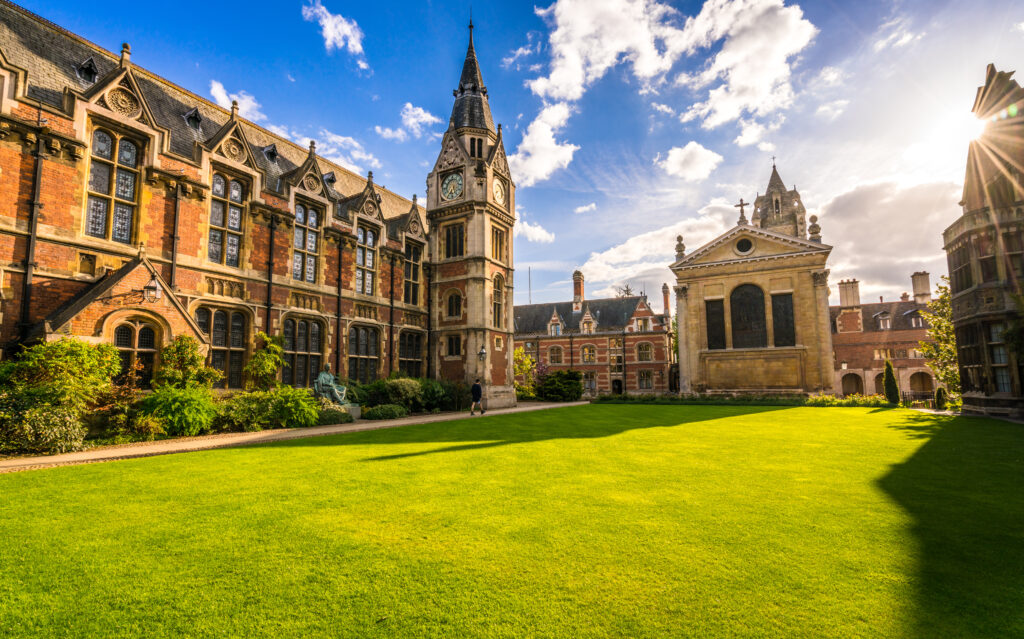
After Cambridge, the conference circuit took me to the SPR at the University of York later that year, the first of many conferences with the Society. The university’s modern campus lies outside the city proper in a bubble of contemporary academic architecture, distinctly lacking anything that would draw a dark tourist, but York itself is another story. Founded as the Roman fortress of Eboracum, reshaped as the Viking capital Jórvík, and consolidated as a medieval ecclesiastical and judicial center, York has accumulated execution sites, prisons, mass graves, and places of public punishment alongside its sacred architecture, producing a dense historical continuity of conquest, incarceration, and sanctioned violence that readily manifests in ghostlore, tourism, and cultural memory. This dynamic is exemplified by the Golden Fleece, a Grade II listed inn (a protected public house of architectural or historical significance) documented as early as 1503 and now styled “York’s Most Haunted Pub,” whose extensive roster of spirits—ranging from Lady Alice Peckett and a trampled Victorian boy to a WWII airman, “One-Eyed Jack,” and a “Grumpy Old Man”—has attracted popular paranormal media attention, notably Most Haunted in 2005, and continues to anchor ghost tours, while also housing material signifiers of historical violence such as the replica skull of Elizabeth Johnson, executed in 1800. This underscores how such venues function simultaneously as commercialized haunted spaces and repositories of historical memory. York Castle Museum offers a contrast: Located within former prison buildings on a site of nineteenth-century executions, material culture and documentary history take precedence over ghost narratives yet inevitably resonate with the city’s dark reputation. After dark, York’s ghost walks—most notably the Original Ghost Walk of York, founded in 1973 and believed to be the oldest in York, if not the world—thread the city’s snickelways and the shambles, to reveal sites such as the Treasurer’s House, scene of the Roman soldiers reported by Harry Martindale in 1953, which formed a key piece of evidence for my 2021 entry in the Bigelow Institute for Consciousness Studies essay competition (Ruickbie, 2024). The enduring pull of York’s darkness lies less in death itself than in the persistence of enchantment, the sense that older mythologies and non-physical agencies remain active within the city’s fabric, making York exemplary of dark tourism not as a fixation on mortality but as a return to depth, where history, myth, and the sacred remain entangled and experientially available.
In November 2014, with the family in tow, we travelled to Cornwall for the Annual General Meeting of the Friends of the Museum of Witchcraft (Ruickbie, 2014b). We stayed in Boscastle at the Wellington Hotel, a picturesque but precariously sited coastal inn firmly embedded in local paranormal culture, where staff readily shared accounts of unexplained sounds, sightings, and nocturnal disturbances, reinforcing the sense that haunting in Cornwall functions less as anomaly than as an extension of place, history, and storytelling, sustained by local tradition, visitor expectation, paranormal media exposure (Most Haunted was here in 2004), and an environment perpetually poised on the edge of the uncanny. The visit combined the Museum of Witchcraft, whose collections place modern Pagan practice alongside longer histories of fear, persecution, and folk magic—where the gift shop supplied a scrying disk as dark as a solid shard of night—with a trip to Tintagel Castle, dramatically perched above the Atlantic and inseparable from Arthurian legend, haunting, and tales of sorcery, an encounter heightened by a sudden storm that reinforced the landscape’s habitual framing as hostile and liminal. Crossing Bodmin Moor on the return journey brought us to the isolated Jamaica Inn, immortalized in Daphne du Maurier’s Jamaica Inn (1936), where landscape, legend, and criminality converge to produce fascination and dread, a narrative logic mirrored in the inn’s contemporary reputation for haunting, sustained by reports of unquiet spirits and poltergeist activity, and placing it among Britain’s most haunted pubs by reputation (Ruickbie, 2013). Taken together, Cornwall’s witchcraft museum, Arthurian stronghold, haunted inns, and gothic literary afterlife exemplify dark tourism as an engagement with echoes of enchantment resounding in a liminal landscape embedded in myth and legend.
Taken together, Cornwall’s witchcraft museum, Arthurian stronghold, haunted inns, and gothic literary afterlife exemplify dark tourism as an engagement with echoes of enchantment resounding in a liminal landscape embedded in myth and legend.
In 2015, the focus moved to the Old Royal Naval College (ORNC), leased to the University of Greenwich, hosts of the next SPR conference. Designed principally by Christopher Wren and Nicholas Hawksmoor, the monumental Baroque architecture of the ORNC projects imperial order and authority in its grand symmetrical façades, domes, colonnades, and axial courtyards while framing the River Thames as a ceremonial extension of state and naval power. Originally the Royal Hospital for Seamen, the complex’s history includes the relocation of the remains of thousands of sailors and officers who died while being treated there. Their remains were removed from the hospital site in 1875 and re-interred elsewhere. This mass disinterment and removal of remains underscores a profound, institutional connection to death and disturbance, lending itself to a framework of institutional gothic. This anonymous mass death is punctuated by specifics. Visitors can tour the Nelson Room, where Lord Nelson’s coffin was held prior to his being laid-in-state. Such history is overlaid with fantasy as the site features as the backdrop to movies such as Skyfall (Mendes, 2012) in the James Bond franchise, Victor Frankenstein (McGuigan, 2015), and The Conjuring: Last Rites (Chaves, 2025). To add a final touch of darkness and reinforce the nautical theme, the brass handbell used to get our attention during the conference was stamped RMS Titanic.
Travelling to the SPR conference at the University of Leeds in 2016, I was drawn to 30 East Drive, Pontefract, an unassuming former council house widely regarded as the strongest contender for “the most haunted house in England,” where the owner, filmmaker Bil Bungay, invited me to stay on the fiftieth anniversary of the original poltergeist outbreak that established its reputation. After joining a commercial ghost hunt for the first part of the night, I spent the remainder alone in the house, a site associated with unusually intense and physical phenomena during the late 1960s, later attributed by investigators to the spirit of a Cluniac monk known to the family as Fred, including reports of a child being violently dragged upstairs and objects levitated and thrown, such as a marble described as having been “projected balistically” at a visitor’s head. Bungay has been central to the site’s media afterlife, transforming a private domestic haunting into a sustained form of dark tourism through his film When the Lights Went Out (Holden, 2012), his book The Black Monk of Pontefract (Bungay & Estep, 2019), the carefully retrofurnished interiors evoking the late 1960s and early 1970s, and the controlled rental of the property to ghost-hunting groups and individuals. The darkness of 30 East Drive lies not simply in a time-limited poltergeist episode, but in the way that event has been reinterpreted, preserved, and amplified, marking a transition from a traumatic family experience to a publicly consumed haunting in which the house itself becomes the primary locus of fear, exemplifying how intense but finite phenomena are converted into enduring dark heritage through narrative accumulation, media repetition, and visitor expectation.
In July 2019, I was in Paris for the Parapsychological Association’s conference, held to coincide with an anniversary of the Institut Métapsychique International and accompanied by a commemorative exhibition. Serendipitously, my hotel lay just around the corner from the entrance to the Paris Catacombs. A monumental example of continental dark heritage, the Catacombs contain the remains of more than six million people, accessed through a portal inscribed with the dramatic injunction “Arrête! C’est ici l’empire de la Mort,” and although lines form early, once inside visitors quickly disperse into a labyrinth of tunnels running beneath the city and, disquietingly, beneath the conference venue itself. Created from 1788 onward as a rational response to the crisis of overflowing cemeteries, the Catacombs are an engineered ossuary in which skulls, femurs, and tibias are meticulously arranged into walls, pillars, and arches, transforming anonymous human remains into architectural and aesthetic forms, punctuated by moralizing inscriptions that frame the site as a didactic confrontation with mortality rather than a mere repository of the dead. The inclusion of identifiable historical figures, among them victims of the French Revolution such as Robespierre, Danton, and Corday, collapses temporal distance by absorbing individual lives into an undifferentiated mass, while the lone officially recorded death within the Catacombs themselves, that of the doorkeeper Philibert Aspairt in 1793, who became lost and died in the darkness, underscores the ever-present proximity of danger (Ruickbie, 2019c). Descending into the Catacombs thus functions simultaneously as a historical encounter, a ritualized journey, and an embodied memento mori, exemplifying a form of dark tourism in which the visitor is compelled to participate, however briefly, in a space explicitly designed to remind the living of their own impermanence.
The next stop, Aberdeenshire, brings the discussion back to the 2018 visit to Crathes Castle that opened this article, undertaken while presenting a paper on “Victorian Ghosthunters in the Twenty-First Century” (Ruickbie, 2018), during which ghosthunting seemed to intrude upon the conference itinerary itself as I travelled by public transport along rural roads in search of darkness, mindful of the last bus back to my hotel. The excursion took in New Slains Castle, a roofless ruin precariously perched on coastal cliffs north of Aberdeen and closely associated with Bram Stoker, who referenced Slains in The Watter’s Mou’ and The Mystery of the Sea, and whose distinctive octagonal hall is widely regarded as a visual inspiration for the chamber described in Dracula; here, architectural liminality, literary association, and reports of haunting, most notably by Victor Hay, 21st Earl of Erroll, converge to produce a site suspended between history and imagination. Back in Cruden Bay, waiting at the Kilmarnock Arms where Stoker had stayed repeatedly in the 1890s while writing substantial portions of Dracula, I was shown the guest book bearing his signature, an encounter that elicited a quiet intensification of attention and temporal layering, the signature functioning as an unsacralized material relic whose contingent survival generated an effect analogous to Walter Benjamin’s concept of aura (Benjamin, 1968), grounded not in death but in traces of presence and continuity. This imaginative and affective register was disrupted by the transition to former HM Prison Peterhead, a Victorian-era high-security prison that operated into the late twentieth century, where enclosure, surveillance, and the architecture of control replaced ruin and imaginative projection; its reputation as “Scotland’s gulag,” reinforced by endemic brutality and the 1987 riot, hostage taking and SAS intervention, resists romanticization and foregrounds a stark contrast between two modes of darkness. Sequenced together, New Slains and Peterhead Prison clarify a central tension within dark tourism between enchantment and its negation, revealing how the numinous can arise both through literary imagination and liminal traces of presence, and through confrontation with the coercive limits of modern rationality, the uncontrollable chaos of criminality and institutional violence.
Sequenced together, New Slains and Peterhead Prison clarify a central tension within dark tourism between enchantment and its negation, revealing how the numinous can arise both through literary imagination and liminal traces of presence...
In November 2019, while in London for an SPR Study Day, the pull of the dark led me to the Tower of London and the Jack the Ripper Museum in Whitechapel, which I will focus on here for brevity. Housed in a narrow mid-nineteenth-century brick townhouse on Cable Street, the museum operates as a concentrated example of sensationalized dark tourism, staging the 1888 murders as an immersive spectacle within a modest Victorian domestic interior that is simultaneously authentic and unsettling, repositioning the visitor from distant observer to intimate witness through dim lighting, narrow staircases, and reconstructed crime tableaux. The curatorial emphasis rests heavily on the murders and their perpetrator, while also gesturing toward the broader social conditions of Victorian Whitechapel and the lives of the victims, with shrines to the canonical women placed alongside macabre artifacts such as constable Edward Watkins‘s police whistle, truncheon, and notebook case he had at the moment of discovering the body of Catherine Eddowes—objects presented less as archival evidence than as relics charged by proximity to violence. Since its opening, this approach has been controversial, particularly given the museum’s initial approval as a “Museum of Women’s History,” with critics arguing that its spatial narrative, ascending through suspects, murders, and forensic speculation, risks reinscribing the voyeurism and commodification that characterized contemporary press coverage and re-centers the figure of the killer despite memorial gestures toward the victims (Hayward, 2015). During my visit, an explicitly supernatural element emerged informally rather than curatorially, when the front desk attendant volunteered accounts of alleged hauntings, including unexplained sounds and disturbances, especially in an upstairs room staged as the lodgings of suspect Francis J. Tumblety, aligning the museum with vernacular traditions of haunted heritage despite its ostensibly historical remit. The Jack the Ripper Museum thus occupies an uneasy position between forensic reconstruction, gothic theatre, and contemporary ghostlore, exemplifying the moral instability of dark tourism when intimate, gendered violence is rendered immersive, personalized, and commercially mediated.
Taken together, these journeys trace a wide and heterogeneous terrain of dark sites encountered over a five-year period, spanning universities, cities, rural landscapes, domestic interiors, monumental institutions, ruins, prisons, museums, and subterranean spaces. The experiences themselves were equally varied, ranging from guided tours, conferences, and exhibitions to solitary overnight stays, chance encounters with material traces, informal storytelling by staff, and moments of phenomenological disruption. Some sites foregrounded spectacle and commercial immersion, others emphasized archival history or material culture, while many blended these registers with vernacular narratives of haunting and presence, or simply lay in the landscape unmediated and inviting self-directed discovery. What unites this sequence is not a single mode of engagement but the cumulative breadth of encounters through which darkness was accessed, staged, curated, narrated, or quietly encountered across different social, architectural, and historical contexts, providing the empirical ground for our analysis.
Fear of the Dark
What really is “dark tourism,” and why do people do it? As noted earlier, the term itself was introduced by Foley and Lennon in the mid-1990s to describe tourism centered on sites and representations of death, disaster, and atrocity, particularly as these are mediated, curated, and commodified within late-modern heritage and tourism economies (Foley & Lennon 1996; Lennon & Foley, 2000). Running in parallel, Seaton’s (1996) early formulation of “thanatourism” reframed such practices in motivational terms, treating them as forms of travel oriented toward actual or symbolic encounters with death: visiting sites of execution and mass mortality, touring memorials and places of internment, encountering symbolic representations of death, or observing reenactments. Stone (2006) later sought to impose conceptual order on this disparate range through his “spectrum” of dark tourism, proposing a continuum of “shades of darkness” based on authenticity, educational intent, temporal distance from the originating event, and entertainment value. Rather than classifying all death-related sites as equivalent, Stone argued that meaning emerges from gradation, context, and perception.
Light’s (2017) retrospective assessment of two decades of research (1996–2016) was less sanguine. He observed that while dark tourism had become a mainstream academic topic, its conceptual coherence had weakened. The term had stretched so far that it increasingly overlapped with heritage tourism, losing explanatory power. Crucially, Light concluded that research had failed to demonstrate that dark tourism constituted a distinct category at all, and noted the field’s persistent Eurocentrism.
Wight and colleagues (2025) further complicated matters by introducing what they called practitioner perspectives. Their interviews revealed a consistent rejection of the label “dark tourism” among attraction managers and curators, who preferred terms such as remembrance, memorial, or heritage tourism. They argued that academic discourse often imposes a sensationalist framework misaligned with practitioners’ educational or commemorative aims, proposing instead a model of co-created ideation between scholars and industry. Yet these “practitioners” are commercial suppliers, not the visitors themselves. Their reluctance toward the term reflects reputational management rather than motivation. As my itinerary has shown, the impulse to explore the dark long predates ticket booths and gift shops, and an alliance between academia and industry would only serve to compromise the objectivity of research.

These debates illustrate a deeper problem: Dark tourism studies have become preoccupied with definition and self-critique. This article cannot entirely escape that charge either. It is undeniably difficult to distinguish dark tourism from ordinary tourism—our heritage is, after all, inescapably dark. Almost every landscape is mulched with the crimes of the past. Yet this ubiquity does not exhaust the phenomenon. There remains a specific motivation to seek out darkness deliberately.
What, then, was I seeking? And was it really all about death?
None of the sites I visited was reducible to death alone. Death is everywhere—at home, in the street, and in modern societies, largely sequestered in hospitals and nursing homes (Dasch et al., 2015). No one tours intensive care wards, attends strangers’ funerals, or lingers outside mortuaries for their delight or edification. If dark tourists just wanted death, that is where they would go. Instead, death itself is commonplace and, absent personal attachment, curiously uninteresting. Evidently, something more than mortality is at work.
Dark Rites
Before “dark tourism,” there was “legend tripping” (Dégh & Vazsonyi 1971, 1983): visits to sites associated with folklore or haunting, often undertaken as dares and interpreted as rites of passage. Participants crossed boundaries between the real and the imaginary, testing courage and belief. Had legend tripping simply matured into dark tourism, or had an older term been forgotten and replaced?
Long before either label, landscapes were already populated with ghosts and those seeking them out. Victorian Britain and America teemed with phantom narratives, from the sensational Twenty-Seventh Street Ghost of New York to the exploits of organized gangs of ghost hunters reported in the press (Ruickbie, 2013). John Ingram’s Haunted Homes and Family Traditions of Great Britain (1884) offered one of the first ghostly gazetteers, anticipating the modern guidebook. Mystery and the unexplained have always drawn crowds.
My own research into contemporary ghost hunting suggests motivations that combine the search for truth with the thrill of pursuit (Ruickbie, 2019b). Ghost hunting functions as both legend tripping and dark tourism: visitors enter reputedly haunted spaces not merely to observe, but to experience. One of my most striking encounters occurred during a commercial ghost hunt at 30 East Drive, Pontefract. We did not simply pass the time; we were tested. The night bore the structure of ritual—ordeal, uncertainty, collective tension, and set tasks to perform—and the satisfaction at dawn was not entertainment alone, but relief and validation. The experience echoed the trials of ancient mystery cults more than a themed attraction.
From a classical anthropological perspective, dark tourism can be understood as a ritualized confrontation with mortality in societies that otherwise medicalize or conceal death and with the supernatural in those same societies that taboo and disallow it. Building on Hertz (1907) and van Gennep (1909/1960), visits to sites of darkness, however presented, allow participants to cross symbolic boundaries in controlled ways. The tourist does not simply observe traces of death but enters a liminal zone.
Victor Turner’s (1969) concepts of liminality and communitas sharpen this view. Ghost walks, prison tours, and paranormal investigations involve structured sequences, shared emotional intensity, and temporary suspension of ordinary norms, producing fleeting but potent collective identity. Dark tourism here is not spectacle but existential engagement through ritualized exposure.
Dark tourism here is not spectacle but existential engagement through ritualized exposure.
The Night-Side of Tourism
We are instinctively drawn to darkness. Catherine Crowe’s The Night-Side of Nature (1848) documented Victorian fascination with the uncanny, séances, and hauntings—an early expression of the same pull visible today. Across cultures and periods, humans seek controlled encounters with danger, death, and moral transgression. Evolutionarily, attention to threat and taboo may rehearse survival responses; culturally, it allows fear to be encountered without collapse.
This instinctual pull is precisely what Nietzsche, Freud, and Jung sought to theorize. Nietzsche’s (1886/2002) abyss, Freud’s (1919/2003) uncanny, and Jung’s (1953) shadow each describe why humans are compelled toward what terrifies and transforms them.
Nietzsche’s (1886/2002) aphorism—“when you gaze long into an abyss, the abyss also gazes into you”—captures the existential risk of prolonged engagement with darkness. The abyss is not merely external evil but latent human capacity. Immersion transforms the observer; attention to darkness reshapes perception and ethical constraints as part of an ontological encounter.
Freud’s (1919/2003) unconscious offers a parallel reading. The abyss resembles the repository of repressed drives that return as the uncanny—simultaneously familiar and alien. Dark tourism becomes a structured confrontation with repressed cultural anxieties: death, violence, and moral ambiguity encountered at a safe distance, yet capable of psychic disturbance.
Jung’s (1953) shadow completes the triad. The shadow comprises rejected aspects of the self that must be integrated for individuation. Dark tourism and ghost hunting can thus be understood as ritualized shadow work: socially sanctioned encounters with collective and personal darkness. Haunted spaces externalize what culture disowns, allowing confrontation without disintegration.
Across all three frameworks, engagement with darkness carries transformative risk. The abyss, the uncanny, and the shadow are mirrors. Dark tourism offers a socially mediated abyss—accessible, structured, and repeatable—where observation and enactment merge.
Re-Enchantment and the Dark Sacred
Part frisson, part memento mori, dark tourism operates as both Gothic titillation and existential meditation—a psychotherapeutic encounter with the “night side” beyond social taboo. Its ritual character aligns it with mystery cults and pilgrimage in re-imagined form. Cemeteries, crypts, catacombs, prisons, and haunted houses intersect with religious architectures, re-sacralizing spaces in a secular age. The sequestration of mortality is reversed, death is confronted rather than hidden, revealing what I call a “dark sacred”—a felt presence of the abyss, the uncanny, and the shadow, where psychic intensity and ritualized experience converge, giving renewed access to the numinous.
This raises the question of whether “tourist” is even the right term. Like pilgrimage, dark tourism emphasizes journey and ordeal, leading to transformation—an active process of discovery contrasting with passive belief and the formal structures of doctrine. Sites such as Peterhead Prison, the Paris Catacombs, or reputedly haunted houses, such as 30 East Drive, function as Turner’s “centers out there” (Turner & Turner, 1978): set-apart spaces demanding existential and emotional engagement—the Nietzschean abyss in anthropological terms; the uncanny and shadow become topography.
Such sacralization does not require faith. It accesses the religious without being religion. It involves spirituality without theology. Motivations are hybrid and often implicit, the draw is instinctual. The act of visiting itself confers significance (Collins-Kreiner, 2010). The journey is a step outside disenchantment, temporarily leaving behind means-ends rationality and bureaucratic control, to seek again the ground of enchantment while preserving self-identity within secular modernity (Ruickbie, 2005).
Reproduction, Power, and Conflict
This process does not happen on neutral territory. Dark tourism is inseparable from narrative. Drawing on Dégh and Vázsonyi’s (1983) concept of ostension, legends are not merely told but enacted. Visitors arrive primed by story, behave accordingly, and sometimes generate experiences that reinforce the legend or resist its control—that was certainly my experience at Crathes and 30 East Drive. Haunting is co-produced by site, guide, visitor, and expectation—all with competing roles.
Haunted sites thus function as spaces of performative hauntology. The ghost is not a relic but a living cultural artifact, sustained through repetition and shared affect. Its power lies in presence, not historical absence—a point that resonates with Derrida’s (1994) hauntology. At Crathes Castle, this dynamic was palpable: guide, audience, and alleged specter were all activated within the experience.
Commercialization stabilizes and reproduces these patterns. Media, tourism, and consumer ritual standardize how paranormal experiences are imagined and felt, packaging the dark sacred into repeatable forms (Berger & Luckmann, 1966; Bourdieu, 1977; Couldry, 2003; Goffman, 1959). Yet this reproduction generates tension. Sites encode power: whose suffering is foregrounded, whose is erased, who profits? The Jack the Ripper Museum exemplifies the commodification of gendered violence; heritage more broadly reflects political memory regimes (Ashworth et al., 2007).
The paradox is acute. Dark tourism simultaneously degrades experience into a product and preserves it as contemporary liminality. The danger is that living ritual ossifies into production-line spectacle. Yet, as my itinerary showed, visitors sometimes disrupt this process—reclaiming narrative control, de-commercializing experience, and returning it to living folklore. In those moments, dark tourism is not consumption but re-enchantment, igniting a modern ritual encounter with the abyss that still has the power to look back.
In those moments, dark tourism is not consumption but re-enchantment, igniting a modern ritual encounter with the abyss that still has the power to look back.
Dark Enlightenment
Across the sites visited here—from castles, prisons, and catacombs to haunted houses, museums, inns, and even conference venues—the darkness encountered was never reducible to death alone. Death was present everywhere, but it functioned primarily as a gateway rather than an endpoint: a threshold through which enchantment, memory, moral anxiety, and the numinous were reactivated. What drew visitors, myself included, was not mortality as biological fact, but the persistence of presence, the sense that certain places exceed their material histories and continue to exert affective, imaginative, and potential supernatural force. Dark tourism, in this sense, is less about corpses than about contact: with the past, with taboo, with the shadowed margins of modern rationality, and with the dark within us all.
Seen anthropologically, these practices are best understood not as a discrete tourism niche but as a contemporary reworking of much older ritual impulses. Pilgrimage, legend tripping, ghost hunting, and visits to sites of negative emotional or imaginative intensity all enact controlled descents into liminal space, where ordinary social norms are suspended and existential questions become temporarily unavoidable. Whether framed as entertainment, education, remembrance, or curiosity, such journeys repeatedly reproduce the same structural pattern: separation from the everyday, immersion in a charged environment, and reintegration marked by narrative, reflection, or transformation. Turner’s liminality and communitas, Jung’s shadow, Freud’s uncanny, and Nietzsche’s abyss converge here not as metaphors imposed from outside, but as analytic descriptions of what participants actually do and feel.
From this perspective, dark tourism emerges as a gothic re-enchantment acting within secular culture, a counter-current of implicit resistance and desire. In societies that sequester death, medicalize suffering, and marginalize the supernatural, dark sites function as unofficial sacred spaces—Turner’s “centers out there”—where forbidden topics can be approached obliquely and safely. Prisons, catacombs, execution sites, and haunted houses operate as negative sanctuaries: places set apart by density of meaning, where visitors submit themselves to emotional, moral, and sometimes physical ordeal to transcend the ordinary. Belief is not required. The act of going is sufficient. Significance accrues through presence, attention, and repetition rather than doctrine.
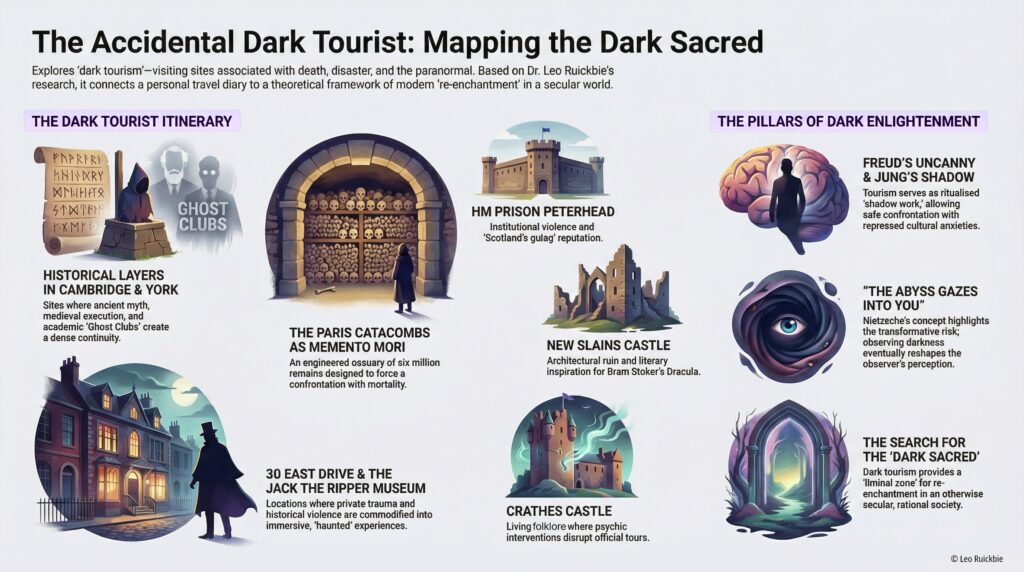
At the same time, these spaces are never neutral. They are produced and reproduced through narrative, power, and commercial mediation. Ostension ensures that legends are not merely retold but reenacted; hauntology reminds us that ghosts persist not as residues of the past but as active cultural agents sustained through performance and expectation. The tourism industry stabilizes these dynamics, standardizing experiences while simultaneously risking their exploitation and reduction to spectacle. The Jack the Ripper Museum demonstrates how easily dark sacralization slides into ethical instability, particularly when gendered violence is aestheticized and commodified. Yet the process is never fully controlled. Visitors, guides, and researchers continually disrupt, reinterpret, and reanimate sites, returning them—at least temporarily—to living folklore rather than static heritage.
The episode at Crathes Castle crystallizes this tension. A guided tour slipped into an unscripted ritual; a psychic intervention challenged institutional management of haunting; an academic audience found itself simultaneously consuming, producing, and altering dark tourism discourse in real time. The little ghost girl in the kitchen was not simply a static “ghost story” but a moment of enacted belief, reflexivity, and co-produced meaning. Whether or not one accepts the ontological reality of the spirit is beside the point. What matters is that the event now circulates as narrative, has entered the site’s evolving folklore, and illustrates how dark tourism remains dynamically unfinished, forever escaping the rational control of the industry that attempts to harness it.
Dark tourism, then, is neither merely morbid curiosity nor simply another branch of the heritage industry. It exceeds its own categorization and commodification. It is a modern ritual practice through which individuals trapped within the Weberian “iron cage” of secular society instinctually reopen contact with the dark sacred: with death, yes, but also with exhilarating fear and the terror of mortality, the shadow of their own psyche and the collective psychic residues of history—activating forbidden enchantment, chthonic strata of spirituality, repressed mythic cycles and the existentially disturbing suspicion that reality exceeds its official explanations. Dark tourism is a two-way mirror: the “dark tourist” is simultaneously observer and participant, shaping and being shaped by the sites they visit, producing experiences that are as transformative—and as ethically charged—as any religious pilgrimage. Given the deep psychological nature of this activity and the ubiquity of “darkness” in our cultural heritage, we are all accidental dark tourists. The difference lies only in whether one notices, lingers, and allows the abyss, however briefly, to look back.
Ashworth, G. J., Graham, B., & Tunbridge, J. E. (2007). Pluralising pasts: Heritage, identity and place in multicultural societies. Pluto Press.
Berger, P. L., & Luckmann, T. (1966). The social construction of reality: A treatise in the sociology of knowledge. Anchor Books.
Bourdieu, P. (1977). Outline of a theory of practice. Cambridge University Press.
Bosselmann-Ruickbie, A. (2019). Protection against evil in Byzantium: Magical amulets and their survival from the early to the late Byzantine period. In J. Nobe & D. Zamani (Eds.), Visions of enchantment: Occultism, spirituality and visual culture. Fulgur.
Bungay, B., & Estep, R. (2019). The Black Monk of Pontefract: The world’s most violent and relentless poltergeist. Independently published.
Chaves, M. (Director). (2025). The Conjuring: Last rites [Film]. New Line Cinema.
Collins-Kreiner, N. (2010). Researching pilgrimage: Continuity and transformations. Annals of Tourism Research, 37(1), 44–60. https://doi.org/10.1016/j.annals.2009.10.016
Couldry, N. (2003). Media rituals: A critical approach. Routledge.
Crowe, C. (1848). The night side of nature; or, Ghosts and ghost seers (Vols. 1–2). George Routledge and Sons.
Dasch, B., Blum, K., Gude, P., & Bausewein, C. (2015). Place of death: Trends over the course of a decade—A population-based study of death certificates from the years 2001 and 2011. Deutsches Ärzteblatt International, 112(29–30), 496–504. https://doi.org/10.3238/arztebl.2015.0496
Dégh, L., & Vázsonyi, A. (1971). Legend and belief. In D. Ben-Amos & K. S. Goldstein (Eds.), Folklore: Performance and communication (pp. 281–304). Mouton.
Dégh, L., & Vázsonyi, A. (1983). Does the word “dog” bite? Ostensive action: A means of legend-telling. Journal of Folklore Research, 20(1), 5–34.
Derrida, J. (1994). Specters of Marx: The state of the debt, the work of mourning, and the new international. Routledge.
Durkheim, E. (1912/2001). The elementary forms of religious life. Oxford University Press.
Ellis, C., Adams, T. E., & Bochner, A. P. (2011). Autoethnography: An overview. Forum Qualitative Sozialforschung / Forum: Qualitative Social Research, 12(1). https://doi.org/10.17169/fqs-12.1.1589
Foley, M., & Lennon, J. J. (1996). JFK and dark tourism: A fascination with assassination. International Journal of Heritage Studies, 2(4), 198–211. https://doi.org/10.1080/13527259608722175
Freud, S. (1919/2003). The uncanny. Penguin Classics.
Goffman, E. (1959). The presentation of self in everyday life. Doubleday.
Halliday, R., & Murdie, A. (2010). Cambridge ghosts. The History Press.
Hartzman, M. (2015). The embalmed head of Oliver Cromwell: A memoir. Curious Publications.
Hayward, C. (2015). History at work: The Jack the Ripper Museum. National Council on Public History. https://ncph.org/history-at-work/jack-the-ripper-museum/
Hertz, R. (1907/1960). Contribution to a study of the collective representation of death. In Death and the right hand (pp. 27–86). Free Press.
Holden, P. (Director). (2012). When the lights went out [Film]. Ash Mountain Films.
Ironside, R. (2018). Studying the supernatural: A review of the Supernatural in Contemporary Society Conference at Robert Gordon University, Aberdeen. Paranormal Review, 88, 18–21.
Jung, C. G. (1953). Psychological aspects of the persona and the shadow. In Collected works of C. G. Jung (Vol. 7). Princeton University Press.
Kasdan, L. (Director). (1988). The accidental tourist [Film]. Warner Bros.
Lennon, J. J., & Foley, M. (2000). Dark tourism: The attraction of death and disaster. Continuum.
Light, D. (2017). Progress in dark tourism and thanatourism research: An uneasy relationship with heritage tourism. Tourism Management, 61, 275–301. https://doi.org/10.1016/j.tourman.2017.01.011
McGuigan, P. (Director). (2015). Victor Frankenstein [Film]. 20th Century Fox.
Mendes, S. (Director). (2012). Skyfall [Film]. Eon Productions; Metro-Goldwyn-Mayer; Columbia Pictures.
Nietzsche, F. (1886/2002). Beyond good and evil: Prelude to a philosophy of the future. Cambridge University Press.
Ruickbie, L. (2005). The re-enchanters: Theorising re-enchantment and testing for its presence in modern witchcraft (Unpublished doctoral dissertation). King’s College London.
Ruickbie, L. (2012). A brief guide to the supernatural. Robinson.
Ruickbie, L. (2013). A brief guide to ghost hunting. Robinson.
Ruickbie, L. (2014a). Estranged and enchanted eroticism: The role of nudity in the depiction of witchcraft and Wicca. Paper presented at Visions of Enchantment: Occultism, Spirituality and Visual Culture, University of Cambridge, Cambridge, UK.
Ruickbie, L. (2014b). Naked in their rites: The meaning of nudity in witchcraft and Wicca. Paper presented at the Friends of the Boscastle Museum of Witchcraft AGM, Boscastle, UK.
Ruickbie, L. (2017). A night with the Black Monk. Paranormal Review, 83, 8–17.
Ruickbie, L. (2018). Victorian ghost hunters in the 21st century: Conflict, continuity and the Society for Psychical Research. Paper presented at the Supernatural in Contemporary Society Conference, Robert Gordon University, Aberdeen, UK.
Ruickbie, L. (2019a). The devil’s livery: The role of nudity in the depiction of witchcraft, Wicca and Satanism. In J. Nobe & D. Zamani (Eds.), Visions of enchantment: Occultism, spirituality and visual culture. Fulgur.
Ruickbie, L. (2019b). Haunters and hunters: Popular ghost hunting and the pursuit of paranormal experience. In D. Caterine & J. Morehead (Eds.), The paranormal and popular culture. Routledge.
Ruickbie, L. (2019c). In the empire of the dead: A journey through the catacombs of Paris. Paranormal Review, 91, 16–19.
Ruickbie, L. (2024). The ghost in the time machine. Bigelow Institute for Consciousness Studies.
Seaton, A. V. (1996). Guided by the dark: From thanatopsis to thanatourism. International Journal of Heritage Studies, 2(4), 234–244.
Stone, P. (2006). A dark tourism spectrum: Towards a typology of death and macabre related tourist sites, attractions and exhibitions. Tourism: An Interdisciplinary International Journal, 54(2), 145–160.
Turner, V. (1969). The ritual process: Structure and anti-structure. Aldine.
Turner, V., & Turner, E. (1978). Image and pilgrimage in Christian culture. Columbia University Press.
Tyler, A. (1985). The accidental tourist. Knopf.
van Gennep, A. (1909/1960). The rites of passage. University of Chicago Press.
Wight, C., Podoshen, J. S., Wyatt, B., & Lennon, J. J. (2025). Rethinking dark tourism: Practitioner perspectives and future research directions. Tourism Recreation Research, 1–14.


In this issue of Mindfield, the contributors examine the theme of “Dark Tourism and Legend Tripping.” In his first column as PA President, Gerhard Mayer suggests that despite declining institutional support, parapsychology remains a vital and evolving field grounded in tradition, renewed by qualitative research, global perspectives, and emerging consciousness studies. Leo Ruickbie details how academic …