by Romain Jallet, Béatrice Bertrand, and Claude Berghmans


by Romain Jallet, Béatrice Bertrand, and Claude Berghmans
Each day, Place Denfert-Rochereau welcomes visitors seeking thrills and waiting for official access to the Catacombs of Paris. As of January 31, 2023, 603,684 visitors had been registered for the exhibition,[1] an average of 1,960 people per day. But not all of them use this official entrance.[2]
These illegal explorations are dangerous given the possibility of cave-ins and the likelihood of getting lost, so much so that in 2022, Senator Bruno Rojouan alerted the Minister of the Interior[3] about this trend in urban exploration (urbex). These fashionable practices are widely publicized in the media and evoke memorial tourism (Crahay, 2014; Folio, 2016), which continues to appeal to Europeans (Hayoz, 2022). Urban underground spaces are also the subject of fantasies that we will attempt to demystify using a critical multidisciplinary approach.
We will trace the history of the Catacombs of Paris and provide a summary of the fantastic stories surrounding them. Then, we will study their inhabitants—“cataphiles”—and urbex as a form of thanatourism and social rebellion. Finally, we will draw on the imagination that surrounds the tunnels to propose a new way of understanding these stories through the prism of exceptional or anomalous experiences (Cardeña et al., 2014).
History and Development of the Catacombs of Paris
The term “catacombs” comes from the ecclesiastical Latin catacumbae and tumba, referring to a tomb. It is a “long underground passageway used or having been used as a burial place or ossuary.”[4] This popular term is “inappropriate” (Faudot, 2023, p. 56) because the Catacombs of Paris contain piles of bones rather than tombs as in ancient times. Several civilizations have sought out natural or man-made underground galleries to store their dead. This is the case with hypogea (Leroy & Recchia-Quiniou, 2021), which are not necessarily intended to be places of worship. These underground burials ceased from the 6th century onwards (Faudot, 2023) in favor of either cremation or burial with or without a container. Our relationship with death has changed over the centuries: from places of socialization before the 13th century, cemeteries have gradually been taken over as ritualized places of remembrance (Déchaux, 1997).
Beyond an architecture of death (Ciambelli, 2012), the digging of these tunnels was initially planned for the mining of gypsum and limestone[5] for the construction of buildings on the surface (Peirazeau & Gelez, 2017). Thus, from antiquity until the early 19th century, excavations were carried out “to construct the city’s buildings and monuments,” then used “to empty the unsanitary cemeteries” within the city walls (Thomas & Duval, 2021). The bowels of the French capital are a labyrinth of stone dug by quarrymen from the late Middle Ages to the 19th century (Guini-Skliar et al., 2000). The galleries extend for nearly 300 kilometers and can reach depths of up to 40 meters, with the taphophile network sinking between 6 and 27 meters[6] below the asphalt. Gérards (1892)[7] and Dunkel (1885)[8] noted their presence at only 2.5 meters below Rue d’Alleray and at more than 40 meters below Rue Gabrielle in Montmartre, for example.
Several factors influenced this development: population growth in cities (Faudot, 2023); religion, which favors burial[9] of remains over other methods of treating bodies (Faudot, 2023); and issues of hygiene and public health (de Dainville-Barbiche, 2014). Villagers were buried in their parish, either in the church under the floor for the wealthiest, or in the cemetery in mass graves for the vast majority (de Dainville-Barbiche, 2014). Congregations and other religious places (convents, asylums, hospitals, etc.) had areas dedicated to the burial of bodies.
Following repeated complaints about the smells coming from these places and fears of epidemics connected to the decomposition of bodies,[10] the Parliament of Paris issued in 1765 a decree prohibiting all burials within the city walls and inside churches (Bertrand, 2016). In 1780, the collapse of one of the walls of the Saints-Innocents cemetery into the cellars of the Gravelot restaurant on Rue de la Lingerie forced the authorities to decide to empty the cemetery, which stood more than two meters above the level of the surrounding streets (Thomas, 2015). Parisians were concerned about the fate of their ancestors, and the decision was made to transfer their remains to the shallowest underground levels, two meters below ground (Thomas, 2015). These were the former quarries,[11] which were converted into ossuaries starting in 1785 (Ciambelli, 2012). It took more than two years to empty the Saints-Innocents cemetery. Remains from other Parisian cemeteries were transferred there until 1860, as were bones found sporadically during construction work until 1960 (Guini-Skliar et al., 2000).
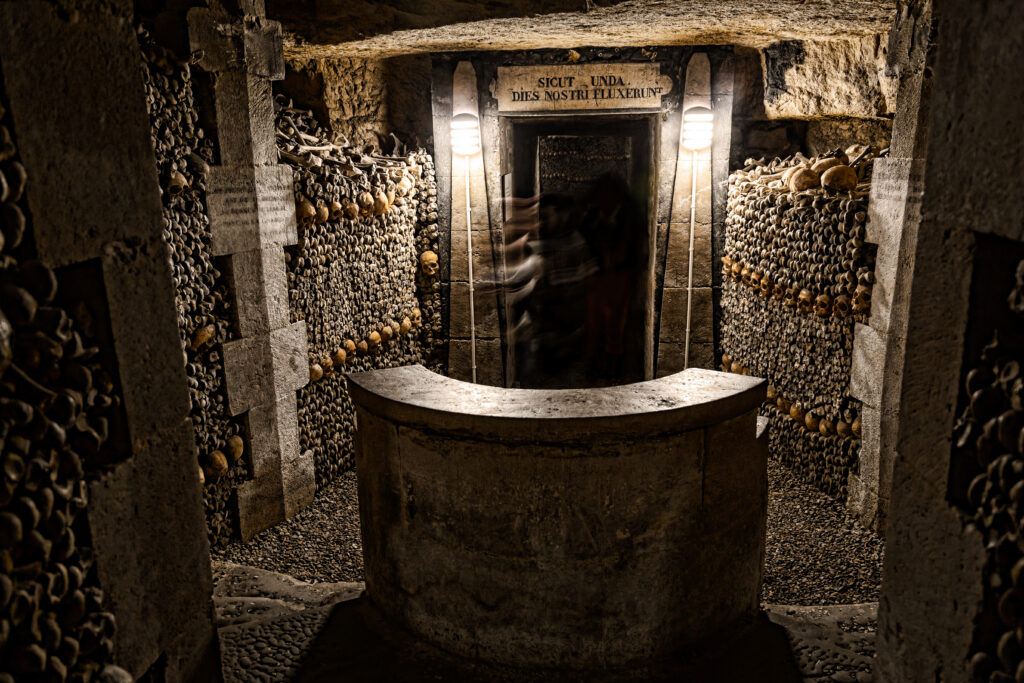
The quarries became the municipal ossuary of Paris, but only a small portion of them were used for this purpose, indeed. The aesthetic arrangement of the bones as we know it today is the work of Héricart de Thury. Long bones and skulls follow one another “in a romantic-macabre scenario”; a veritable “gathering place and chaotic jumble of disintegrated, fragmented skeletons” (Ciambelli, 2012, p. 81).
These underground passages served as a refuge for smugglers, thieves, and poachers seeking to escape the police and customs officers (Peirazeau & Gelez, 2017). They were also a favorite spot for illegal activities such as prostitution. More recently, they have been used as a route for the city’s sewers, a storage place for breweries, and even a biospeleology laboratory. They were considered for use in the passive defense of Paris during the two world wars and were a hideout for German troops during World War II (Guini-Skliar et al., 2000).
Today, the catacombs are a fabulous space for passing through and socializing.
Some Rumors and Legends of Underground Paris
Scharnitzky (2007) defines a rumor as “inaccurate or exaggerated information that becomes distorted as it is transmitted directly by word of mouth or indirectly via the media…” (p. 35). Rumors have a social function. Like urban legends, it is difficult to trace their origins; they start out as real events that are then more or less distorted through various psychosocial mechanisms (Renard, 1994).
The catacombs have been the subject of speculation in literature since the 19th century, and even in academic circles and the media, without sufficient evidence to support these claims.[12] Thomas (2015) writes: “We are led to believe that the ‘Catacombs of Paris’ are places where political groups, secret societies, sects, and drug users gather, to which we can add skinheads, punks, followers of black masses and satanic rituals…” (p. 72). The educational file of the Museums of Paris[13] indicates that the catacombs have had a “notorious reputation” (p. 32) since their development; parties are said to be organized there, sometimes concerts.[14]
Rumors circulate about the devil of Vauvert, whose story is recounted by Gérald de Nerval (1928). The author describes “one of the oldest inhabitants of Paris” (Nerval, 1928, p. 237) who is said to have lived in the Château de Vauvert on Rue de l’Enfer. There are references to a “familiar spirit” (Nerval, 1928, p. 238) and horrified reports from neighbors about the noise coming from inside the house. The police reportedly heard the sound of breaking glass and strange, high-pitched laughter. Investigations were carried out at these locations and, in the absence of results, the conclusion was clear: “The noise came from the catacombs located… under this neighborhood” (Nerval, 1928, p. 239). It was never possible to get to the true facts of the story: “only, from time to time, did the inexplicable pranks of the old Chartreuse and the Château de Vauvert recur in Paris” (Nerval, 1928, p. 311). Mention is made of “gunshots heard every day at sunset,” “mysterious applause,” “rains of toads,”[15] and a “rain of hundred-sous coins” (Nerval, 1928, p. 311). Although these are only rumors, they seem to us to be similar, in parapsychology, to the classic phenomenology of a poltergeist (Roll, 1972, 1977) or even, in the imagination that this fuels, to an experience of haunting[16] (Houran & Lange, 2001; Laythe et al., 2022).
People claiming to be “sorcerers” said they were able to arrange encounters with the devil in the underground passages in exchange for money (Thomas, 2015). Such demonstrations could be compared to freak shows, i.e., presentations of monsters, subjects with physical characteristics considered unusual, or more simply, a living cabinet of curiosities. On a similar theme, Thomas (2015) reports the existence of a “Green Man,” also known as the “Ghost of Montsouris” (p. 85). The tunnel workers feared the appearance of such a specter, as it would prove to be an ominous omen; in addition, there are reports of apparitions of white ladies and, in particular, the night washerwomen (Jallet, 2024b).
Among these rumors was one about the organization of Masonic lodges,[17] which Thomas (2015) mentions in his novel Les Mystères des carrières Montmartre by Fortuné du Boisgobey,[18] in which the Compagnons de la Truelle meet under Montmartre. The catacombs would be an ideal location for any clandestine gathering, as their “labyrinthine structure [allows] for multiple exits to be used as escape routes in the event of a sudden retreat” (Thomas, 2015, p. 76). The author mentions the Talpa people, from La Double Vie de Théophraste Longuet, of whom Gaston Leroux (1904) gives a most strange description: they have the physical characteristics of cave dwellers.[19]
Disappearances have been reported on the surface and may help to reawaken our deepest fears. We can link these rumors to the 1793 disappearance of Philibert Aspairt, whose remains were not found until 1804 (Thomas, 2015). A plaque has been erected in his memory in the 5th arrondissement under Rue Henri Barbusse. According to Peirazeau (2021), Aspairt is part of the founding myth of cataphile culture. Some say that his spirit still haunts the underground passages. The imprint of his memory thus persists in the collective memory. The internet is paved with stories of black markets, black magic rituals, and even séances. There are also rumors of secret chambers used by alchemists during the Middle Ages.
When fantasy is not involved, it is more likely to be “parties” or nights spent by the destitute, taking advantage of the warmth of the Montmartre gypsum quarries after the workers have finished their day (Guéroult, 1881). However, festivities are organized there and regularly mobilize the police.[20] These gatherings are promoted through social media and are named with the prefix “Kta”[21] (Thomas, 2015); these gatherings are feared by the catacombs caretakers due to possible damage.
Explorers of an Invisible Space: Cataphiles, a Secret Society?
According to Dauphin (2019), the term “cataphile” is a neologism, “used since the late 1970s to describe enthusiasts of the Paris Catacombs who refer to themselves by this name” (p. 146). Cataphiles originate a unique and autonomous socio-cultural movement, albeit one marked by secrecy (Peirazeau, 2015, 2021). Without limiting the definition, Thomas (2015) mentions cataphiles includes students from prestigious universities, medical and arts programs, etc., as well as scouts and intellectuals. Glowczewski and Matteudi (1983) highlight their great socio-demographic diversity and have managed to extract a classification with twelve typical profiles. Cataphiles are difficult to identify statistically due to the illegality of their practice. They do not appear to come from a specific social background but may have a higher than average level of education; it is a practice that seems to be particularly prevalent among young adult males, although it is becoming increasingly popular among females (Dauphin, 2019). They are perceived as a “secret society” (Glowczewski & Matteudi, 1983; Lebreton & Héas, 2007) due to their distrust of newcomers[22] (Dauphin, 2015). These stereotypes are persistent and are reinforced as these individuals go out at night so as not to be seen (Thomas, 2015).
According to Dauphin (2019), the term “cataphile” is a neologism, “used since the late 1970s to describe enthusiasts of the Paris Catacombs who refer to themselves by this name” (p. 146). Cataphiles originate a unique and autonomous socio-cultural movement, albeit one marked by secrecy.
Going down[23] means complying with norms that more or less explicitly dictate the rules and behaviors to be adopted, alone or in community. Cataphiles “inhabit” the Paris Catacombs, and the contrary also seems to be true.[24] In a way, it is a question of “inhabiting a monument” in the sense used by Fabre (2010). This ability to respect established underground norms allows for cohabitation and thus for living with others while exploring the catacombs, embodying a form of social cohesion (Dauphin, 2019).
Having evolved from an activity centered on visiting and even secret gatherings[25], the catacombs have gradually become the subject of land use planning. There are reports of excursions lasting several days in a row, “[becoming] a true second home that cataphiles share in the manner of a giant roommate situation” (Peirazeau & Gelez, 2017, p. 15). The consideration of the catacombs as an “underground living space” (Peirazeau & Gelez, 2017, p. 16) marked the beginning of their development as we know it today. There is intragroup communication via leaflets, which gives cataphiles an individual and collective identity (Pepin Lehalleur, 2014).
The Parisian underground is an “interstitial space,” or rather, an “urban interstice” (Peirazeau & Gelez, 2017, p. 7). Cataphiles occupy the “voids” of an in-between space, neither quite on the surface nor quite on the margins, insofar as they fall within a legal framework that effectively includes them in society. As we review the references, we observe a dual movement between individual and collective appropriation, but also legal and illegal appropriation, or “clandestine” appropriation, as Peirazeau and Gelez put it (2017, p. 8). Art enthusiasts practice painting, sculpture, and photography there. Nevertheless, their works can be perceived as vandalism, distorting the markings and traces left by the quarry workers’ techniques. Some map the sites and restore entire sections, giving them “heritage value” (Peirazeau & Gelez, 2017, p. 8). There is therefore a “collective reappropriation of common goods and a desire to preserve an identity” (Peirazeau & Gelez, 2017, p. 9), with cataphiles fulfilling a real and necessary social function. However, Peirazeau and Gelez (2017) argue that the actions of cataphiles operate according to a “process of heritage preservation” (p. 10), beyond the notion of risk, which falls to the state.[26] Others cannot accept this idea of appropriation of a place they consider to be timeless and to have existed before them.[27]
There is a novel approach referred to as “autonomous archaeology” (Peirazeau & Gelez, 2017, p. 11) and an “arts of doing” (Dauphin, 2019, p. 131). In our view, this form of archaeology is not institutionalized; it is non-institutionalized. Moreover, when admiring these places, one cannot help but be in awe of the subtle blend of past architecture and the works[28] of cataphiles that sprinkle the corners and walls of the great underground boulevards where one encounters—at least in the collective imagination—the intriguing figure of death.
Appropriating Death: On Thanatourism or Dark Tourism
Dark tourism or thanatourism (Dann & Seaton, 2003; Seaton, 1996) is a form of tourism in which individuals become attached to the history of artifacts or even sensitive places (Folio, 2016). Sensitive in the sense that they are closely or remotely connected to death and annihilation, presented in ways that range from subtle to brutal. The catacombs are among these places, along with sites that have been the scene of news events, natural disasters, and even memorials. These spaces elicit an attraction—a fascination—with death. This is what we believe is the case with the catacombs, which serve as an ossuary. Folio (2016) points out that this practice is not solely contemporary, even though renewed interest in these places has been influenced by the media.
This fascination with the macabre has always existed in humans (Seaton, 1996). By exposing visitors to pain and suffering, dark tourism evokes a sense of unease that we will explore from the perspective of the uncanny (Freud, 1919/2013). These places are closely connected to our history and yet charged with a potential that is as confusing as it is attractive: They are, in short, both familiar and disturbing. According to Lennon and Foley (2000), this mixture of contradictory feelings is based on the historical youth of the place: the younger it is, the closer the misfortune is to us and the more likely it is to happen again.
Folio (2016), drawing on the work of Tarlow (2005), Dann (2005), and Ashworth (2004), highlights six motivating factors[29] for thanatourism. Thus, people who engage in this specific form of tourism: have a greater interest in history; are in the process of becoming aware of the past with the idea that the future can be changed; reflect on elements of the past, which allows them to work on their own identity; are seeking redemption or even memory; wish to experience something unusual through transgression; and are more likely to derive pleasure from exposure to the macabre.
Walter (2009) approaches thanatourism as a form of mediation between the dimensions of life and death. As Morisson (2021) points out, it is a bearable appropriation that “compensates for the repression of death, which is taboo in our contemporary societies” (p. 100). For Walter (2009, p. 45), the notion of “ancestors” is fundamental, as it is a way of seeing those who have passed away. This echoes the need for memory that Folio (2016) evokes as a motivation for macabre tourism.
Urbex as Recreational Dissent in the Urban “Wilderness”[30]
Urban exploration involves visiting areas abandoned by human activity, which requires breaking regulations in order to gain access. It is a recreational activity (Garrett, 2014), which Morisson (2021) traces back to the United States in the 1970s with ruin porn. This aesthetic of ruins “consists of entering, sometimes illegally, closed, forgotten, and abandoned places, often dilapidated, to photograph and document them without leaving any traces” (Morisson, 2021, p. 94). Urbex also concerns domestic or industrial ruins. Cataphiles engage in ordeal-like behavior that “playfully and creatively revives [underground] life, now abandoned by the city that manages it” (Peirazeau & Gelez, 2017, p. 8).
It is a form of “alternative adventure tourism”[31] (Lebreton, 2015, p. 44) that belongs to an “underground” culture, i.e., one that is marginalized, countercultural, or even opposed to the mainstream societal model. Urbex is no longer just a confidential practice (Lebreton, 2015); it is a social movement with collectives forming around a shared passion. The sites explored (abandoned factories, old hospitals, etc.) are diverted from their original uses by nighttime wanderings due to the prohibition of entering them.
This wandering should be understood as the appropriation of a place where the individual is cloaked in anonymity, namely a “non-place” (Augé, 1992). These “non-places” are everyday spaces that have no meaning for any of us, where our identity does not take precedence. We are completely anonymous there, strangers. Graillot (2022) situates urbex in a context where individuals nevertheless tend to travel less and avoid risk as much as possible. Such wanderings reflect a psychogeography[32] characterized by the subversion of societal norms; a return to a certain freedom; the creation of new experiences; and the contemplation of urban space and its historicity. Graillot (2022) highlights the appeal of these “confidential recreational practices that mobilize the margins and interstices of time and space not yet invested by a commercial organization” (p. 162). These practices concern outdoor spaces and represent a transgression of the boundaries of society’s legal framework, to the point where Bourdeau and Lebreton (2013) call them “recreational dissidence in nature.”
In our view, going down into the tunnels is part of a continuum between play and transgression (Bourdeau & Lebreton, 2013). By making their way through manholes to immerse themselves underground, cataphiles cross and transcend a boundary between the surface and the Parisian underground. Although they may seem disorganized, these spontaneous practices nevertheless have a solid psychosocial architecture and are carriers and vectors of specific social codes (Bourdeau & Lebreton, 2013). Beneath the surface of the streets and boulevards, cataphiles express their feeling of being “out of time” or “against time” (Lebreton, 2019, p. 17).
Urban Space, Escape, and Imagination
The supposed discovery of a kind of fantastical bestiary beneath Paris, whose contents inspired the book Spectrania[33] (1817), may have influenced our collective imagination. Other such legends may have been fueled by underground tours of Paris organized by unscrupulous individuals (Mercier, 1783). The publication of Description des Catacombes de Paris (Héricart de Thury, 1815)[34] contributed to the interest in the quarries.
Catacombs appeal to the morbid imagination (Dauphin, 2015). Urban environments are conducive to the emergence of the imagination. This is what Naessens (2021) suggests when she shows, based on several collaborative protocols, how urban areas can become spaces for “collective artistic experimentation” (p. 1). Her idea of ”re-enchanting our urban territories” (p. 1) is extremely relevant to the processes of appropriation mentioned above. Some cataphiles[35] engage in artistic practices within the quarries; some paint graffiti[36] on the walls, while others create installations of objects or arrange rooms to play with the lighting. These art objects may be targeted for vandalism by other individuals (Thomas, 2015).
Cataphiles are anonymous, but each has a “blaze” or pseudonym. Either they choose it themselves over time, or it is chosen for them by the group or an experienced member. More than just a symbol, the use of a pseudonym is a way of being, other than on the surface, under the veil of another identity (Dauphin, 2019). This is undoubtedly a form of self-play in which the imagination can invite a certain reverie, an escape through adventure, and even allow a form of resilience and potential reflexivity about one’s existence (Berghmans et al., under review). Being in an “anomic zone” allows one to escape the norms and surveillance that reign on the surface (see Dauphin, 2019, p. 136).
Even though cataphiles are not particularly attracted to death and its treatment (Dauphin, 2015), the Paris Catacombs tend to awaken in everyone fears that are sometimes buried and transmitted through legends and myths. Peirazeau (2021) considers that there are indeed “mythological elements… that symbolically mark the birth of cataphilia” (p. 347). These spaces confront us with death, emptiness, and depth (Revol et al., 2018), challenging the death drive (Freud, 1920/1981) with real, rather than merely metaphorical, risk-taking. This imagery is ambivalent (Bachelard, 2004), especially since cataphiles verbalize their feeling of well-being within the galleries. Are human beings not, as Freud pointed out, constantly drawn toward an inorganic state, from life to death?
Exceptional Underground Experiences:
Towards a Mythology of Subterranean Paris?
Being inside the quarries causes a “change in the biological, ecological, and social rhythms of those who practice there” (Lebreton & Héas, 2007, p. 346). These psychophysiological changes lead to “altered experiences” and a “sensitive emotional state, close to the sacred realm” (Lebreton & Héas, 2007, p. 346). Dauphin (2015) refers to a “truly extraordinary experience” (p. 19). We believe that the psychophysical stress of the cataphiles is likely to create exceptional experiences (ExE), which are perceived as paranormal and may be the source of the rumors and urban legends presented here.
The quarries are located on average twenty meters below Paris (Dauphin, 2019), and cataphiles spend anywhere from several hours to a few days there. This amount of time seems to be sufficient to create an altered state of consciousness. Human beings seem to be universally susceptible to hallucinations in such a state (Clottes & Lewis-Williams, 1996). These explorations could be a precursor to the onset of exceptional experiences (Evrard & Rabeyron, 2023). Such experiences are common in the general population, affecting 30 to 50% of people (Belz, 2009).
Without extrapolating the repercussions, it should be noted that such psychophysiological effects are found in prisoners who are forced into social isolation (Coppola, 2019). It is also worth noting that some cataphiles descend alone, which can be likened to a form of isolation, at least for a few hours.[37] Lieberman (2015) explained that even a short period of social isolation has deleterious effects on humans and leads to sensory deprivation (deprived state). In the case of the catacombs, we believe that this would be a state of sensory attenuation with psychopathological effects similar to the perceptual distortions highlighted by Grassian (1983)—namely: illusions, hallucinations, and sometimes even dissociative disorders.[38] Without being limited to this, we believe that the cataphile experience is likely to induce such a phenomenology, although undoubtedly to a lesser extent due to less drastic material and environmental conditions.
We believe that this would be a state of sensory attenuation with psychopathological effects similar to the perceptual distortions highlighted by Grassian (1983)—namely: illusions, hallucinations, and sometimes even dissociative disorders.
The work of Smith (2006) and Haney (2018, 2003) has highlighted feelings of fear and persecution in contexts of extreme isolation. We can imagine these taking the form of more diffuse and benign sensations of presence within the Paris Catacombs. Gendreau et al. (1972) suggest that one week in isolation would be enough to create sufficient variations in brain activity, expressed, among other things, by the subject’s hypervigilance to their environment. These results, measured by EEG, are similar to those obtained in laboratory experiments on sensory attenuation (Coppola, 2019).
Researchers believe that hallucinatory phenomena regularly occur in underground locations (Clottes, 2004; Clottes & Lewis-Williams, 1996). This explains, among other things, the use of underground rituals for religious purposes in ancient Greece (Ustinova, 2009). This was the case with necromanteion, temples dedicated to the gods Hades and Persephone and to the cult of the dead, where ceremonies inducing states of ritual trance took place (Jallet, 2024a, 2025). Such altered states of consciousness can be very easily induced in the laboratory using a sensory deprivation chamber and a mirror observation procedure known as psychomanteum (e.g., Hastings et al., 2012, 2002; Moody, 1994; Roll, 2004). This device induces in participants sensations of presence and experiences of sensory perceptions of deceased persons, also known as “necrophanies” (Evrard et al., 2021). These experiences are hallucinations and unusual sensory perceptions (Kamp et al., 2019). They are highly variable in terms of phenomenology (Steffen & Coyle, 2011) and appear—among other things—in response to life events such as bereavement in the general population (Kamp et al., 2020).
ExEs are experiences that go beyond commonly accepted rules regarding reality. They are shared by a significant part of the population (Evrard, 2013, 2014; Rabeyron, 2020), contain generally “neutral” clinical elements (Simmonds-Moore, 2003), and are thought to have relatively positive effects on those affected (Simmonds-Moore, 2014). These ExEs include experiences of hauntings or contact with the deceased.
The internet is rife with videos demonstrating that humans need to interact with a supposed afterlife, evidenced by the trend of modern ghost hunts in Paris and elsewhere[39] (inhabited or uninhabited residences, warehouses, abandoned spaces, forests, etc.). Some individuals claim to see spirits protecting places after being buried there. Others report hearing songs whose origin is difficult to pinpoint. These are said to be the echoes of choirs of the deceased. At other times, it is lost souls whose footsteps can be heard echoing through the galleries, as the mythical Green Man terrorizing workers and bandits demonstrates. In terms of haunting, the subject’s environment is likely to metaphorically replay the psychosocial issues of an individual or group (Jallet & Evrard, 2026). These apparitions are described as ghosts,[40] which we approach as mythical experiences (Boccara, 2004).
Conclusion
The Paris Catacombs are among the most iconic locations for dark tourism enthusiasts seeking thrills. They are also home to a unique micro-society: the cataphiles. Visiting the quarries is a form of urban exploration that awakens a collective memory and morbid imagination in everyone. While we do not advocate for the reality of the urban legends presented in this manuscript, we instead take a historical approach based on clinical anthropology. The underground passages of Paris are a dangerous space that confronts humans with risk and uncanny strangeness, and bears witness to their insatiable death drive. This article provides an opportunity to propose the hypothesis that exceptional underground experiences may be one explanation for the development of a unique mythology surrounding this space known as the “Empire of Death.”
[1] See the Paris Musées press release at: https://tinyurl.com/yw8wp6tp
[2] A decree issued by the Prefect of the Seine and the Paris Police Prefecture on November 2, 1955 prohibits unauthorized persons from entering the Paris Catacombs (Dauphin, 2015).
[3] See: https://www.senat.fr/questions/base/2022/qSEQ220327374.html
[4] Dictionnaire Larousse.
[5] The underground galleries are mainly composed of limestone. For more information, readers are invited to refer to the educational file “Catacombes de Paris” produced by A. Rayzal for the Musées de Paris. Available at: https://www.catacombes.paris.fr/ressources. The document details the geology of the catacombs: “The start of the tour takes visitors 20 meters underground and 45 million years back in time. The layer of limestone rock in which the quarries are dug is the result of sedimentary accumulation during the Lutetian period, when the sea flooded the Paris region several times” (p. 4). Other materials were also present: flint chalk, sand, clay, gypsum, and sandstone, all of which were mined differently (p. 10).
[6] See the article in La Provence: https://tinyurl.com/2uj5jm36. In addition, the author Dauphin (2019) mentions a network extending over 300 kilometers at a depth of approximately 20 meters below the surface.
[7] Conductor for the General Inspection of Quarries on the Seine.
[8] As chief mine guard, Dunkel mapped out the quarries (see references).
[9] Faudot (2023, p. 55) points out in particular that burial practices are clearly preferred by the Church to cremation.
[10] Dainville-Barbiche (2014) explains in his article that an investigation of the Saints-Innocents was conducted without yielding any results. Dainville-Barbiche (2014) specifies that the cemeteries of the various parishes were closed in 1765 and should have been replaced by suburban cemeteries. Dainville-Barbiche (2014) emphasizes the sporadic nature of the measures envisaged by the Parisian authorities.
[11] The author writes on this subject: “The site chosen by the municipal authorities is that of the former Tombe-Issoire quarries, beneath the Montrouge plain. It is located outside the city and is easily accessible” (Faudot, 2023, p. 55).
[12] See the chapter “De quelques légendes underground” in Thomas’s book (2015, pp. 71-105).
[13] See: https://www.catacombes.paris.fr/ressources
[14] This is the case for the artist Kiri, whose underground nickname is “Catacombes” (see Investigations, n.d.).
[15] These are reminiscent of the Ten Plagues of Egypt described in the Bible.
[16] For an accessible and critical work on the subject, see Phénoménologie des Hantises by Mallory Clément (2025), which offers an overview, from a heterodox perspective, of the scientific literature on the subject.
[17] Term used by Freemasons to be understood in the context of Masonic meetings and rituals.
[18] See Thomas (2015, p. 75). Novel first published in the newspaper Le Voleur (1876).
[19] Other fantastical writings exist about the imaginary inhabitants of the Paris Catacombs. For more details, see Gilles Thomas’s book (2015).
[20] See the 1999 documentary A Dive into the Basement of Paris by INA Paris Vintage (2024). The police explain that they are taking a more preventive than repressive approach.
[21] Read as “cata.” As demonstrated by the multiple sources used in this publication, this prefix is commonly used in the cataphile community. It is a cultural and linguistic element specific to the cataphile community.
[22] In French: ”néophytes”, meaning people who are not familiar with the Paris underground.
[23] The term “descendre” is commonly used in French by cataphiles.
[24] Florian Dauphin (2019, p. 132) uses a phrase that we find very telling in this regard: “being inhabited by places.”
[25] See Peirazeau and Gelez (2017, p. 15), who date this period to the early 1990s, as explorations were short-lived at that time. The cataphiles interviewed in their study explain the negative effects of media coverage of the Paris underground, with the fact that more and more rooms were being built underground.
[26] The authors explain that the government focuses on maintaining the foundations of Paris solely to prevent risks such as collapse. However, it does not seek to intervene in artistic restructuring, which is precisely where cataphile activity is so important.
[27] We refer to Destroy’s testimony, collected in January 2007 by Peirazeau and Gelez (2017, p. 20): “Appropriation is unbearable. The quarry was there before you and will be there after you. You have to be humble in these places. You cannot own a permanent, timeless place.”
[28] These works can range from the simplest pile of stones to paintings created “underground” or even the decoration of rooms, which generally have a name. Other practices more closely related to street art are also present, such as graffiti, murals, etc. Some places are composed entirely of these works, such as the Ceramics Room, which features mosaics. We refer to the valuable work of Peirazeau and Gelez (2017, pp. 17-18), which includes several photographs of the quarries.
[29] For more details, see Folio’s manuscript (2016). This is only a very brief summary of the ideas proposed by the author.
[30] This terminology is borrowed from the works of Florian Lebreton (2015, 2019), cited in this manuscript.
[31] Lebreton (2015) refers to these meanings in Hudson (2003) and Lynch & Causevic (2008).
[32] In her writing, the author further develops the foundations of this school of thought with several references that we will not highlight here for the sake of brevity. It involves the study of conscious and unconscious interactions between individuals and their environment; among these interactions is the question of spatial planning, for example.
[33] The full title of the work is Spectrania, or a collection of surprising, marvelous, and remarkable stories and adventures of specters, revenants, spirits, ghosts… a manuscript found in the catacombs. It can be consulted on site at the Historical Library of the City of Paris. See: https://tinyurl.com/24fxsmav
[34] An Inspector General of Underground Works for the Department of the Seine.
[35] See Misti’s testimony for Le Parisien at: https://youtu.be/qNRlKtZX6DU?si=NnVw1PZD8niyAs0q
[36] Graffiti and other tags are not always the work of cataphiles. Gilles Thomas (2015) mentions those created by “officials” or workers from the General Inspection of Quarries.
[37] See also geologist Michel Siffre: https://tinyurl.com/3pa66e5a
[38] Grassian has highlighted other psychopathological effects that we will not discuss here.
[39] These points were further developed during two presentations at the study day Parler Avec Les Morts – PALM #2 (Jallet, 2024a) and at the international conference Trance, Art, and Culture (Jallet, 2025).
[40] See, among others: https://www.paristickets.com/fr/catacombs/haunted/. We emphasize the variety of sources available on the internet and their differences.
Ashworth, G. J. (2004). Tourism and the heritage of atrocity: Managing the heritage of South African apartheid for entertainment. In T. V. Singh (Ed.), Tourism seeks new horizons (pp. 95-108). University of Groningen.
Augé, M. (1992). Non-lieux, introduction à une anthropologie de la surmodernité. Seuil.
Bachelard, G. (2004). La Terre et les rêveries du repos. Corti, les Massicotés.
Belz, M. (2009). Außergewöhnliche Erfahrungen. Hogrefe.
Berghmans, C., Batissou, A., & Jallet, R. (under review). La littérature fantastique comme moyen de connexion à une dimension transcendante imaginaire: Un mode d’adaptation face aux états anxio-dépressifs en thérapie d’acceptation et d’engagement, une étude de cas. Psychothérapies.
Bertrand, R. (2016). Génèse d’un cimetière nouveau dans le dernier tiers du XVIIIème siècle. In, R. Bertrand, A. Carol (Eds.), Aux origines des cimetières contemporains. Les réformes funéraires de l’Europe occidentale XVIIIe-XIXe siècle (pp. 66-70). PUP.
Boccara, M. (2004). L’enlèvement au cœur du mythe. In Le mythe: Pratiques, récits, théoriques (Vol. 4: Anthropologie et psychanalyse). Economica/Anthropos.
Bourdeau, P., & Lebreton, F. (2013). Les dissidences récréatives en nature: entre jeu et transgression. EspacesTemps.net. https://www.espacestemps.net/articles/les-dissidences-recreatives-en-nature-entre-jeu-et-transgression/
Cardeña, E., Lynn, S. J., & Krippner, S. (Eds.). (2014). Varieties of anomalous experience: Examining the scientific evidence (2nd ed.). American Psychological Association.
Clément, M. (2025). Phénoménologie des Hantises: Apparitions et poltergeists. JMG Editions.
Ciambelli, P. (2012). Paysages de rêves. In C. Vassas (Ed.), Paysages du religieux (pp. 81-94). Editions du CTHS.
Clément, M. (2025). Phénoménologie des hantises. JMG Éditions.
Clottes, J. (2004). Hallucinations in caves. Cambridge Archaeological Journal, 14(1), 81-82.
Clottes, J., & Lewis-Williams, D. (1996). Les chamanes de la préhistoire: Transe et magie dans les grottes ornées. Le Seuil.
Coppola, F. (2019). The brain in solitude: An (other) eighth amendment challenge to solitary confinement. Journal of Law and the Biosciences, 6(1), 184-225.
Crahay, F. (2014). Tourisme mémoriel. Témoigner, Entre histoire et mémoire, 117, 151-152.
Dainville-Barbiche, S. de (2014). Les cimetières à Paris au XVIIIe siècle: Problèmes d’odeurs et de salubrité publique. In Chappey, J.-L. & Denis, V. (Eds.), Ordonner et régénérer la ville: Entre modernités et révolutions (pp. 51-68). Editions du CTHS.
Dann, G. M. S. (2005). Children of the dark. In G. J. Ashworth, & R. Hartmann (Eds.), Horror and human tragedy revisited: The management of site of atrocities for tourism (pp. 233-252). Cognizant.
Dann, G. M. S., & Seaton, A. V. (2003). Slavery, contested heritage and thanatourism. Haworth.
Dauphin, F. (2015). Les usagers des catacombes de Paris: Société secrète et espace hétérotopique. Les Organisations Utopiennes, 48, 13-24.
Dauphin, F. (2019). Habiter clandestinement les carrières souterraines de Paris: Normalisation et conflits au sein d’un patrimoine. Communications, 105, 131-148.
Déchaux, J.-H. (1997). Le souvenir des morts. Essai sur le lien de filiation. PUF.
Rayzal, A. (n.d.). Dossier pédagogique « Catacombes de Paris ». Musée Carnavalet – Histoire de Paris.
Dunkel, J.-T. (1885). Topographie et consolidation des carrières sous Paris. Morel et Cie.
Evrard, R. (2013). Psychopathologie et expériences exceptionnelles: Une revue de la littérature. L’Evolution Psychiatrique, 78(1), 155-176.
Evrard, R. (2014). Folie et Paranormal. Vers une clinique des expériences exceptionnelles. Presses Universitaires de Rennes.
Evrard, R., Dollander, M., Elsaesser, E., Cooper, C., Lorimer, D., & Roe, C. (2021). Expériences exceptionnelles nécrophaniques et deuil paradoxal: Études de la phénoménologie et des répercussions des vécus effrayants de contact avec les défunts. L’évolution psychiatrique, 86(4), 799-824.
Evrard, R., & Rabeyron, T. (2023). Les expériences exceptionnelles. In A. Bioy (Ed.), Le Grand Livre des transes et des états non ordinaires de conscience (pp. 411-422). Dunod.
Fabre, D. (2010). Habiter les monuments. Terrain, 24, 14-52.
Faudot, M. (2023). Les Cimetières. Des lieux de vie et d’histoires inattendues. Armand Colin.
Folio, F. (2016). Dark tourism ou tourisme mémoriel symbolique? Téoros, 35(1). https://journals.openedition.org/teoros/2862
Freud, S. (1919/2013). L’inquiétante étrangeté et autres essais. Gallimard.
Freud, S. (1920/1981). Au-delà du principe de plaisir. Essais de psychanalyse. Payot.
Garrett, B. L. (2014). Undertaking recreational trespass: Urban exploration and infiltration. Transactions of the Institute of British Geographers, 39(1), 1-13.
Gendreau, P., Freedman, N. L., Wilde, G. J., & Scott, G. D. (1972). Changes in EEG alpha frequency and evoked response latency during solitary confinement. Journal of Abnormal Psychology, 79(1), 54-59.
Gérards, E. (1892). Les Catacombes de Paris. Chamuel, Editeur.
Glowczewski, B., & Matteudi, J.-F. (1983). La cité des cataphiles, mission anthropologique dans les souterrains de Paris. Librairie des Méridiens.
Graillot, L. (2022). Chapitre 7: Un enrichissement de la notion d’exploration à partir d’une analyse de l’urbex. In D. Bourgeon-Renault, C., Petr, & E. Jarrier (Eds.), Théories et pratiques du marketing et du tourisme dans un contexte d’innovation (pp. 162-180). Editions EMS.
Grassian, S. (1983). Psychopathological Effects of Solitary Confinement. American Journal of Psychiatry, 140(11), 1450-1454.
Guéroult, C. (1881). La Bande à Fifi Vollard. Jules Rouff.
Guini-Skliar, A., Viré, M., Lorenz, J., Gély, J.-P., & Blanc, A. (2000). Les souterrains de Paris. Les anciennes carrières souterraines. Nord Patrimoine Éditions.
Haney, C. (2003). Mental health issues in long-term solitary and “supermax” confinement. Crime & Delinquency, 49(1), 124-156.
Haney, C. (2018). The psychological effects of solitary confinement: A systematic critique. Crime and Justice, 47(1), 365-416.
Hastings, A. (2012). Effects on bereavement using a restricted sensory environment (psychomanteum). Journal of Transpersonal Psychology, 44(1), 1-25.
Hastings, A., Hutton, M., Braud, W., Bennett, C., Berk, I., Boynton, T., Dawn, C., Ferguson, E., Goldman, A., Greene, E., Hewett, M., Lind, V., McLellan, L., & Steinbach-Humphrey, S. (2002). Psychomanteum research: Experiences and effects on bereavement. OMEGA: Journal of Death and Dying, 45(3), 211-228.
Hayoz, S. (2022). Analyse de la demande des touristes suisses visitant des sites de « dark tourism » en Europe. [Travail de bachelor, Haute École de Gestion Valais-Wallis].
Héricart de Thury, L. (1815/2000). Description des catacombes de Paris. Editions du CTHS.
Houran, J., & Lange, E. (2001). Hauntings and poltergeists: Multidisciplinary perspectives. MacFarland & Company, Inc., Publishers.
Hudson, S. (2003). Sport and adventure tourism. Routledge.
INA Paris Vintage (2024, January 31). 1999 : plongée dans les sous-sols de Paris [Video]. YouTube. https://www.youtube.com/watch?v=ejdxEkqMohU
Investigations. (n.d.). [Video]. Catacombes , dans les entrailles de Paris. YouTube. https://youtu.be/2f9FnhLh1to
Jallet, R. (2024a, February 21). “Spirit, are you there?”: Rituals of contact with the invisible, from ancient necromancy to modern ghost hunting. Journée d’étude “Parler avec les morts – PALM #2,” Nancy, France. https://hal.science/hal-04647164v1
Jallet, R. (2024b, November 6). Les lavandières de nuit: Dames blanches pernicieuses, empreintes du passage à l’acte criminel. Conference presented for the Société Lorraine de Psychologie, Nancy, France.
Jallet, R. (2025, March 13). Reinventing an ancient ritual of contact with the invisible: From necromantic practices to psychomanteum. International Congress Trance, Art and Culture, Paris, France.
Jallet, R., & Evrard, R. (2026). La hantise comme résonnance de l’héritage familial et du besoin d’autonomie – le cas d’Andromède. In R. Evrard, R. Jallet, & C. Berghmans (Eds.), 16 cas de clinique des expériences exceptionnelles, à paraître. Dunod.
Kamp, K. S., O’Connor, M., Spindler, H., & Moskowitz, A. (2019). Bereavement hallucinations after the loss of a spouse: associations with psychopathological measures, personality and coping style. Death Studies, 43(4), 260-269.
Kamp, K. S., Steffen, E. M., Alderson-Day, B., Allen, P., Austad, A., Hayes, J., Laroi, F., Ratcliffe, M., & Sabucedo, P. (2020). Sensory and quasi-sensory experiences of the deceased in bereavement: An interdisciplinary and intergrative review. Schizophrenia Bulletin, 46(6), 1367-1381.
Laythe, B., Houran, J., Dagnall, N., Drinkwater, K., & O’Keeffe, C. (2022). Ghosted! Exploring the haunting reality of paranormal encounters. McFarland & Company, Inc., Publishers.
Lebreton, F. (2015). L’Urbex, une dissidence récréative en »nature» urbaine. Nature & Récréation, 2, 44-53.
Lebreton, F. (2019). Des pratiques récréatives en nature à contre-temps. Nature & Récréation, 7, 17-19.
Lebreton, F., & Heas, S. (2007). La spéléologie urbaine. Ethnologie française, 37(2), 345-352.
Lennon, J., & Foley, M. (2000). Dark tourism: The attraction of death and disaster. TJ International.
Leroy, M., & Recchia-Quiniou, J. (2021). Préface – Grottes et dolmens. Préhistoires méditerranéennes, 9(2), 7-10.
Lieberman, M. D. (2015). Expert report for United States District Court, Northern District of California, Oakland Division: Ashker et al. v. Governor of the State of California. https://ccrjustice.org/sites/default/files/attach/2015/07/Lieberman%20Expert%20Report.pdf
Lynch, P., & Causevic, S. (2008, October 21). Tourism development and contested communities. EspacesTemps.net. https://www.espacestemps.net/articles/tourism-development-and-contested-communities/
Méheust, B. (2008). Démonothérapies traditionnelles et thérapies modernes. In E. Collot (Ed.), Hypnose et pensée magique (pp. 41-50). IMAGO.
Mercier, L.-S. (1783). Tableau de Paris (Nouvelle éd., corrigée et augmentée, Tome 2). Amsterdam.
Moody, R. (1994). A latter day psychomanteum. In D. J. Bierman (Ed.), Proceedings of presented papers at the 37th Annual Convention of the Parapsychological Association (pp. 335–336). University of Amsterdam: Parapsychological Association.
Morisson, V. (2021). L’urbex: déchiffrage/défrichage critique. Etudes irlandaises, 46(1), 93-106.
Naessens, O. (2021). L’urbain comme lieu d’émergence d’un imaginaire. Péristyles. Cahier des Amis du Musée des Beaux-Arts de Nancy, 57. https://hal.univ-lorraine.fr/hal-03609535v1
Nerval, G. (ed.). (1928). Nouvelles et fantaisies. Librairie ancienne Honoré Champion.
Paris Musées. (2024, January). Communiqué de presse – Fréquentation Paris Musées 2023. https://tinyurl.com/yw8wp6tp
Peirazeau, R. (2015). Clandestinité et patrimonialisation. Cartographie des idéaux et interactions cataphiles au sein des carrières souterraines de Paris [Unpublished doctoral dissertation, École des Hautes Études en Sciences Sociales de Paris].
Peirazeau, R. (2021). Cataphiles. Anthropologie souterraine dans les carrières de Paris. ACP.
Peirazeau, R., & Gelez, T. (2017). L’archéologie autonome et les aménagements cataphiles. ACP.
Pepin Lehalleur, A. (2014). Communication souterraine: L’exemple du tract dans les catacombes de Paris. Galatasaray Üniversitesi İletişim Dergisi, 1, 205-228.
Rabeyron, T. (2020). Clinique des expériences exceptionnelles. Dunod.
Renard, J.-B.. (1994). Entre faits divers et mythes: Les légendes urbaines. Religiologiques, 10, 101-109.
Revol, C., Wunenburger, J.-J., & Mohebi, F. (2018). L’ambivalence de l’imaginaire du souterrain urbain. Géographie et cultures, 107, 91-104.
Roll, W. G. (1972). The poltergeist. Nelson Doubleday, Inc.
Roll, W. G. (1977). Poltergeists. In B. B. Wolman (Ed.), Handbook of Parapsychology (pp. 382-413). Nostrand Reinhold.
Roll, W. G. (2004). Psychomanteum research: A pilot study. Journal of Near-Death Studies, 22(4), 251-260.
Scharnitzky, P. (2007). La fonction sociale de la rumeur. Migrations Société, 19(109), 35-48.
Seaton, A. (1996). Guided by the dark: From thanatopsis to Thanatourism. International Journal of Heritage Studies, 2(4), 234-244.
Simmonds-Moore, C. (2003). Investigating schizotypy as an anomaly-prone personality [Unpublished doctoral dissertation, University of Leicester, UK].
Simmonds-Moore, C. (Ed.). (2014). Exceptional experience and health: Essays on mind, body, and human potential. McFarland.
Smith, P. S. (2006). The effects of solitary confinement on prison inmates: A brief history and review of the literature. Crime and Justice, 34(1), 441-528.
Steffen E, & Coyle A. (2011). Sense of presence experiences and meaning making in bereavement: A qualitative analysis. Death Studies, 35(7), 579-609.
Tarlow, P. (2005). The appealing dark side of tourism and more. In M. Novelli (Ed.), Niche tourism: Contemporary issues, trends and cases (pp. 47–58). Elsevier.
Thomas, G. (2015). Les Catacombes: Histoire du Paris souterrain. Le Passage.
Thomas, G., & Duval, G. (2021). Paris sous Paris, la ville interdite. EPA.
Thury, H. (1815). Description des Catacombes de Paris, précédée d’un précis historique sur les catacombes de tous les peuples de l’ancien et du nouveau continent. Bossange et Masson.
Ustinova, Y. (2009). Caves and the ancient Greek mind: Descending underground in the search for ultimate truth. Oxford University Press.
Walter, T. (2009). Dark tourism: Mediating between the dead and the living. In R. Sharpley, & P. R. Stone (Eds.), The darker side of travel: The theory and practice of dark tourism (pp. 39-55). Channel View Publications.


In this issue of Mindfield, the contributors examine the theme of “Dark Tourism and Legend Tripping.” In his first column as PA President, Gerhard Mayer suggests that despite declining institutional support, parapsychology remains a vital and evolving field grounded in tradition, renewed by qualitative research, global perspectives, and emerging consciousness studies. Leo Ruickbie details how academic …