by Joanna Ebenstein



by Joanna Ebenstein
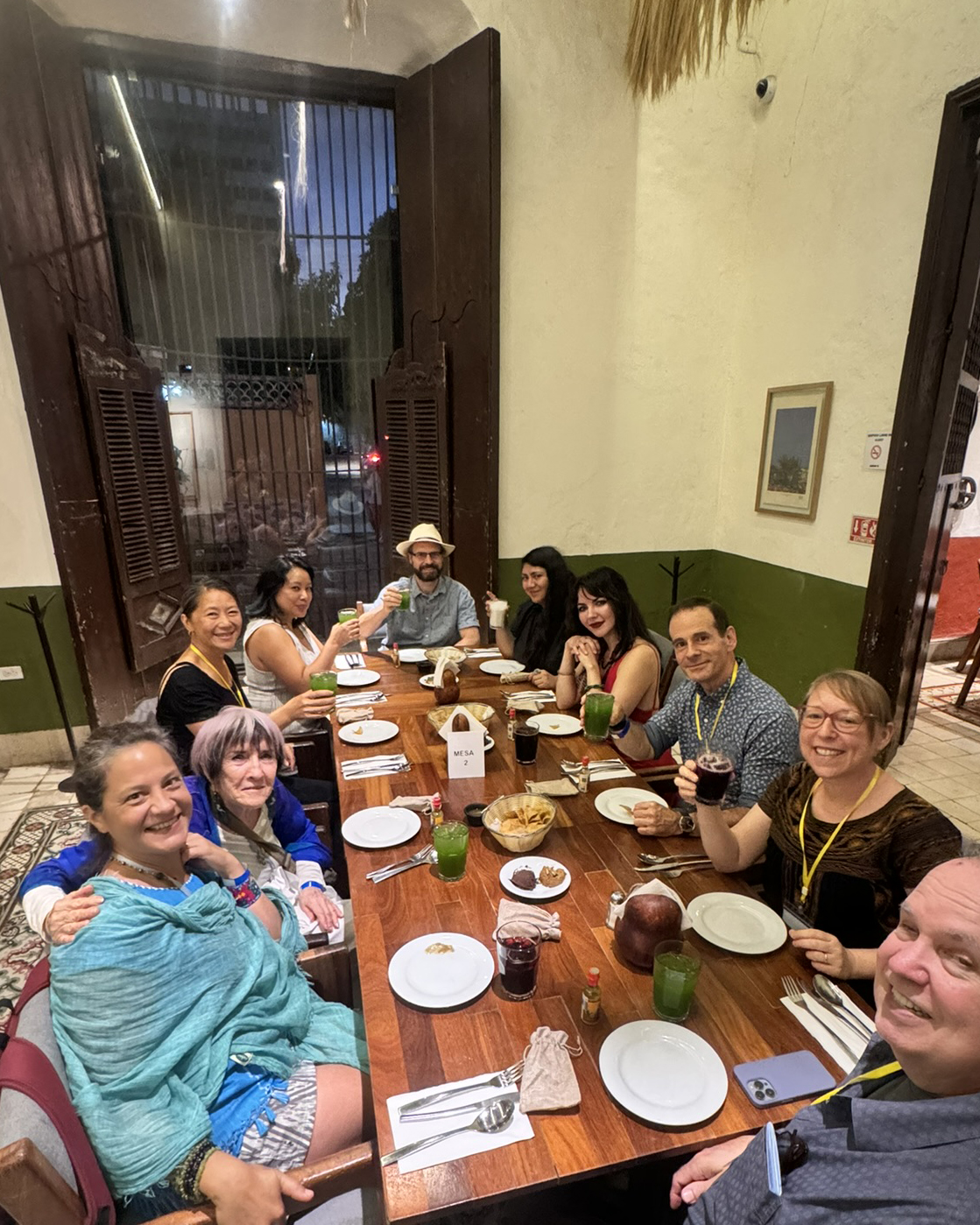
This past August, I had the good fortune—thanks to a kind alert by my friend Shannon Taggart—to attend the 66th Annual Convention of the Parapsychological Association, taking place in Mérida, Mexico, the city in which I happen to live.
Parapsychology is defined as
The systematic [and scientific] study of alleged psychological phenomena involving the transfer of information or energy that cannot be explained in terms of presently known scientific data or laws [including] various forms of extrasensory perception, such as telepathy and clairvoyance [and such] phenomena as poltergeist activity and the claims of mediums. (American Psychological Association, 2018)
As someone who is very much not a scientist, and who is new to this field of research, I was really struck by a number of things over the course of these few days.
And this conference—deftly organized by Executive Director Annalisa Ventola, Program Chair Dr. Erika Annabelle Pratte and Arrangements Chair Ramsés D’León—was packed with a fascinating array of presentations covering a wide spectrum of parapsychological topics, boasting titles such as “Parental Encouragement and Suppression of a Child’s Past-Life Memories”; “Aphantasia, Imagery Vividness, and Exceptional Experiences”; “German Ghosthunters – Results of an Online Survey”; and “Are My Deceased Loved Ones Still with Me?: Mourning and Hope in Mediumistic Practices.” You can see the full schedule of talks here, and read all the abstracts here.
As someone who is very much not a scientist, and who is new to this field of research, I was really struck by a number of things over the course of these few days. My strongest impression was the earnestness and rigor of the individuals involved. It seemed clear to me that the members of this organization are people who are, in good faith, using the scientific method to theorize about—and prove the veracity of—anomalous phenomena. I was particularly impressed by the comments made by association members in response to presentations about experiments. They often contained not just warm words of support, but also suggestions for ways in which the experimenters could work harder to ensure there was no possibility of cheating, intentional or otherwise.
I also found myself fascinated by an observation that came up in a number of talks to the effect that, in the experience of the researchers, psi—defined as “the aggregate of parapsychological functions of the mind including extrasensory perception, precognition, and psychokinesis” (Merriam Websters, n.d.)—manifests more readily when there is both intention and a detachment from the outcome. One researcher said something to the effect of “maybe it’s more about psychology, and maybe that’s the point.”
This highlights one of the things I find so perplexing about the field of parapsychology in general. The very nature of the phenomena it examines seems to be that it is the outlier, the strange exception to the rule, the unrepeatable. It seems difficult—if not impossible—to imagine being able to create conditions in which you could get repeatable results with such phenomena. This seems to be the reason why many of the experiments presented were based around probability and statistics.
Another of my overarching takeaways from this meeting was about diversity. Notably, the voices in the room were not just European and North American, as with many professional conferences I have attended, but also Latin American. One member of the organization pointed out that this was unusual, and had much to do with the choice of Mexico as the location for this years’ meeting. This cultural mix led to wonderful exchanges, as when a Brazilian researcher noted that, for them, the idea of spirit possession—still controversial in the West—was prosaically accepted, because they could, any day of the week, walk into one of their country’s popular Spiritist churches and see it in action. To them, possession was nothing anomalous; it was part of their everyday understanding of the world and what was possible within it. This is an important reminder that it is our worldview and culture that create our categories of what is “normal” and what is “anomalous” in the first place.
It felt to me that many of the members were motivated by the desire to legitimize and normalize such [anomalous] experiences, which tend to be marginalized and stigmatized both within academia and in the world at large.
All of this made me really think about the benefits of diversity more generally, and how the normalization (and integration) of diverse perspectives—the growing inclusion, in academia and popular culture, of individuals with different cultural backgrounds, cosmovisions, styles of neuro-processing, gender and sexual identities—might lead to a richer and more holistic understanding of our world, via an integration of a greater percentage of the human experience. I found myself excited to imagine how our current era’s commitment to bringing previously marginalized voices into the mainstream cultural conversation might go on to change and enrich our collective culture, and expand our ideas of what might be possible.
It was also my impression that the Parapsychological Association was largely made up of people—most of them scientists—who had had their own personal anomalous experiences that had led them to question reality as it is commonly presented. It felt to me that many of the members were motivated by the desire to legitimize and normalize such experiences, which tend to be marginalized and stigmatized both within academia and in the world at large. There seemed to be a strong, shared mission to integrate anomalous experiences, both personally and also culturally, into the wider Western worldview.
Over the course of our days together in that hotel conference room, there were a number of talks that stood out to me. I was very moved by “Direct Vision: A Research Program Exploring Extra-Ocular Vision in Children,” in which Nili Bar detailed work she and her colleagues are conducting with children with autism, ADHD, and depression. Their studies seem to indicate that cultivating the children’s ability to generate extra ocular images—or, in the words of the abstract, “visual images from sources other than retinas”—might help children overcome their difficulties in noticeable ways and live happier and more connected lives. Here, the emphasis was on how parapsychology can help lives, or its therapeutic application.
Another talk—”From Brain Waves to Seismic Beats: A Proposal for Studying Anticipatory Physiological Activity Through Earthquake-Related Stimuli,” delivered by Rodrigo Arriola—looked at whether we might be able to tap into subconscious pre-cognitive knowing to predict earthquakes. In the course of this talk, we learned that, remarkably, three major earthquakes have taken place in Mexico City on the same date—September 19th—and that this was the day that the city also stages its earthquake drills.
Yet another talk, Gerhard Mayer’s “Psi as a Threat – The Poltergeist Case of Carol Compton,” looked at the fascinating case of a Scottish nanny working in Italy in the 1980s. Fires continuously sprung up in the homes of her wards, ultimately leading to a messy and confused trial in which she was accused of arson and attempted murder. The speaker made the case that an understanding of—or allowing for the possibility of—psi could have provided swifter justice for the young woman.
Another standout was Alex A. Álvarez’s “Is Psi Rooted in Biology? A Theoretical Proposal Based on Consilience.” Álvarez, an evolutionary biologist, speculated—based on many cases of known animal psi, or supernormal animal abilities—that psi might be a part of the biological makeup of all vertebrates. What might make human beings unique are the outer layers of our brain—newer, from an evolutionary standpoint—which largely inhibit this latent function.
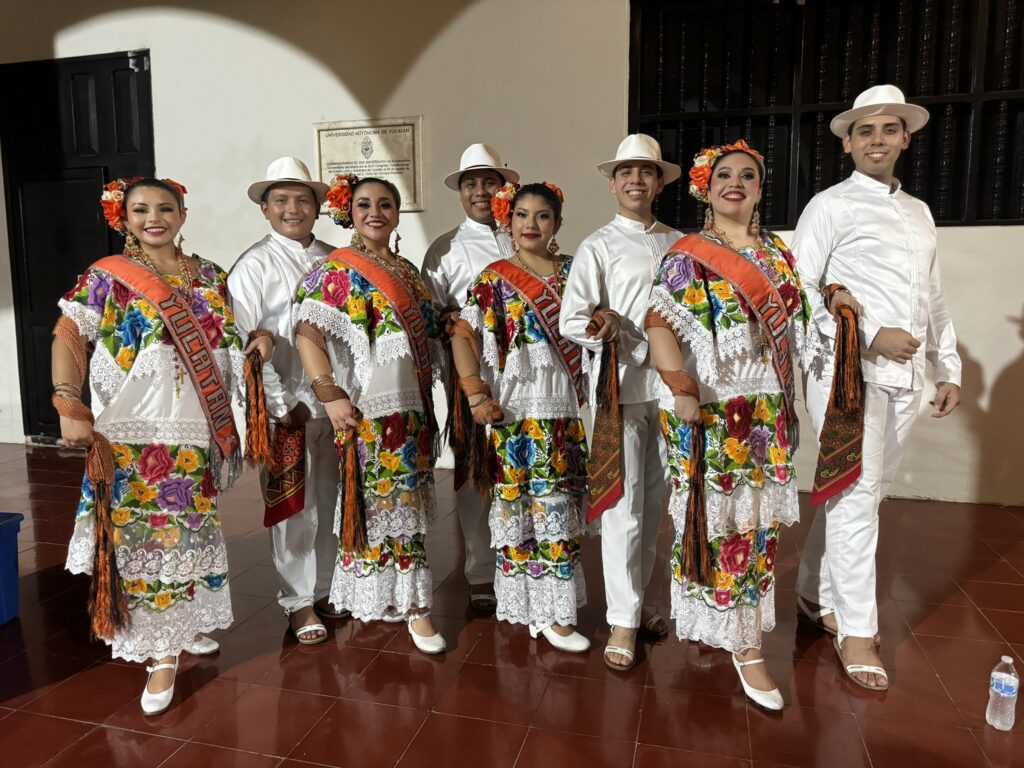
I also really enjoyed James McClenon’s “Online Group PK Experiments: Recent Results and Hypothesis Testing,” which linked psi, religion, and shamanism and Nuria Ciofalo’s “Indigenous Psychologies from Cem Anahuac (Mesoamerica),” in which we learned about the nuances of a fascinatingly different pre-Hispanic indigenous worldview while enjoying a Mayan-inflected Yucatecan feast.
If all this makes you curious to know whether you might possess psi abilities, one of the talks—”The Return of a High Performing Psi Participant: Behavioral Results of an ESP Task with EEG” by David J. Acunzo—introduced a series of internet games designed to locate people with extraordinary abilities. You can test yourself on their platform psiarcade.org.
American Psychological Association. (2018). Parapsychology. In APA dictionary of psychology. Retrieved October 19, 2024, from https://dictionary.apa.org/parapsychology
Merriam-Webster. (n.d.). Psi phenomena. In Merriam-Webster.com dictionary. Retrieved October 19, 2024, from https://www.merriam-webster.com/dictionary/psi%20phenomena



In this issue of Mindfield, the contributors examine the theme of “Mapping the Unseen: Psi, Media, and the Cultural Imagination.” The editorial by Jacob W. Glazier, Anastasia Wasko, and David S. B. Mitchell examines how fictional narratives can create the cultural space in which new scientific ideas and research agendas emerge. In his Presidential Column, …

by Carl Lorenz Cervantes